
Golf Instruction
Golf Slope Rating and How It Relates to Your Golf Game

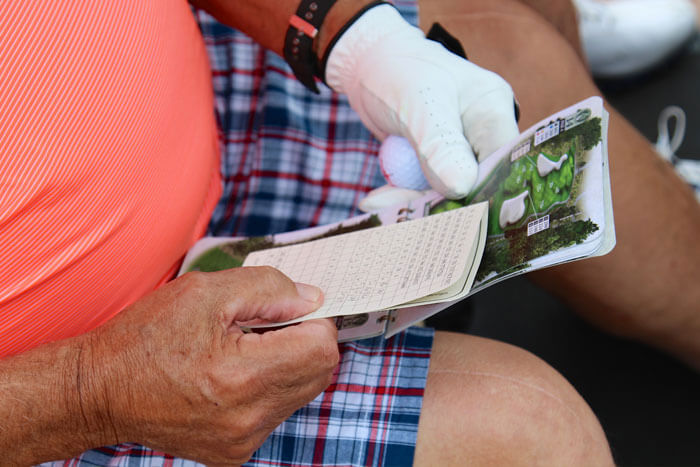
A golf scorecard is full of numbers. When you grab a scorecard to put into your pocket prior to walking to the first tee, you probably only pay attention to a few of those numbers – such as the par for the course and the total yardage. Most golfers decide which tees to play based on the yardage that is outlined on the card—a high handicapper may want to keep the total yardage down around 6,000 yards, a mid-handicapper will be okay at around 6,500, and an accomplished player will be glad to take on a challenge of 7,000 yards or more. No matter what level of player you are, the yardage for the course can tell you a lot about which tees are best for your game.
However, there are other numbers on the scorecard that warrant your attention. Specifically, there are two other numbers that should be noted – the course rating, and the slope rating. Many golfers think of these two numbers as being different versions of the same thing, but they are actually quite different. The difference lies in the intended ‘audience’ for the ratings.
A course rating is a number that is aimed at a scratch golfer, while the slope rating is meant as a way to measure difficulty for a player who is not a scratch golfer as compared to players who are. This concept should become clearer as we move through this detailed explanation of what golf slope rating is and how it relates to your own golf game.
What is a Golf Course Rating?
Before getting into slope rating, we should first make sure that you have a good understanding of course rating. This number is usually the first of the two numbers listed next to each tee box on the score card.
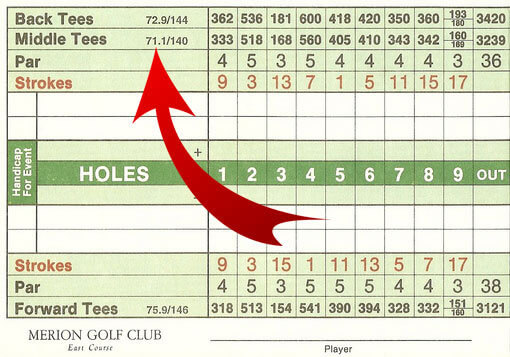
Golf course rating as indicated on a traditional scorecard. Photo via Flickr.
The course rating, according to the USGA, is meant to “evaluate the playing difficult of a course for scratch golfers under normal course and weather conditions.” The number is expressed with a single decimal point, and will usually hover somewhere around par for the course.
Easier courses will have a course rating slightly under par, while harder courses will come in above. For example, an easier course may have a course rating of 70.5, while a difficult course could be rated at 75 or even higher.
What About a Golf Slope Rating?
Moving on to slope rating, we shift the discussion away from a scratch golfer and onto more of an “average” player. The USGA defines a bogey golfer as someone who has a handicap around 20 and can hit a typical tee shot around 200 yards. Slope rating is intended more for the purposes of this kind of player, as it helps to “level the playing field” between a scratch golfer and a bogey golfer.
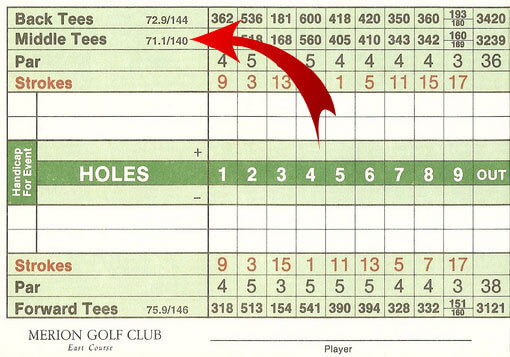
Golf slope rating indicated on a traditional scorecard. Photo via Flickr.
So, basically, if you are entering a competition that is going to include players of all various skill levels, you are going to look to the slope rating to determine the way that handicaps will be applied.
When it Comes to Golf Slope Higher = Harder
As you might suspect, a higher slope rating is going to equate to a more difficult golf course for the average golfer to play. The “standard” or base slope rating is 113, meaning a course that is rated at 113 will play to a standard difficulty level. From there, the ratings can go up and down all the way from 55 up to 155.
If you see a slope rating that falls anywhere in the double digits, you can expect that course to play rather easy, even for a bogey golfer. On the other hand, taking on a course with a slope rating in the 130’s or 140’s is going to present a serious challenge to a player with a mid or high handicap.
Why the Difference Between Course and Slope Rating?
Why is there a need for both a course rating and a slope rating? It comes down to the way that scratch golfers and bogey golfers get around the course. A bogey golfer is going to be punished more harshly on the scorecard than will a scratch golfer when playing a challenging course.
For example, if a course has many forced carries off the tee, the bogey golfer will likely incur some penalty strokes along the way – while the scratch player should be able to avoid these hazards altogether. Therefore, the slope rating acts as a sliding scale to give the higher handicap player the help they need to compete in a net competition. If the system were as simple as just saying a course is ‘two strokes harder than normal’, for instance, the better player would win out almost every time.
Setting Goals for Your Game
Even if you aren’t playing in a competition, you can still use the information that is provided by the slope rating to help set goals for your day on the course. For example, imagine that you are an 18 handicapper, and you usually set your sights on breaking 90 for a round. When you tee it up at a new course, you can glance at the slope rating to decide what kind of scoring goal is realistic for the day. If you are playing a course with a slope in the 130’s, you might want to aim for something under 95 as opposed to 90. On the other hand, a course with a slope in the low 100’s may allow you to aim for an 85 – or even lower.
Also, you can consult the slope rating before starting a round to decide which tees you should play. On a course with a low slope rating, you may feel comfortable stepping back a set and taking on a few hundred extra yards. On a difficult course, however, moving up and playing from a little bit shorter would likely be the wise choice.
Another suggestion would be to keep track of your scores over time as compared to the slope rating of the courses you’ve played—a golf scorecard keeper like this one is often an excellent way to keep old scorecards organized. By comparing your scores to the slope rating at courses you’ve played in the past you’ll be able to identify trends and see if your game is truly improving after factoring in the “difficulty” variable of the courses you’ve been playing. Additionally, over time you’ll become more adept at seeing what is a good score for your game at each slope rating you take on.

You don’t have to become an expert on the course rating system used by the USGA in order to have fun on the course, but you should at least understand the basics. Now that you have an idea of what course rating and slope rating are all about, you can consult them prior to your next round to make smart decisions about which tees to play and what kind of score is achievable.
Cover Photo via Flickr



LIV Golf Could Be Facing its Final Chapter

Foresight GC2 Review: A Surprisingly Affordable Launch Monitor From Foresight

FIRST LOOK: Rapsodo MLM2XPRO Adds Putting, Faster Performance & More

FIRST LOOK: Titleist’s 2027 Pro V1 and Pro V1x Are Officially Showing Up on Tour

2026 Presidents Cup Preview: Did Team USA Get It Right?
2026 Presidents Cup Preview: Did Team USA Get It Right?
FIRST LOOK: Rapsodo MLM2XPRO Adds Putting, Faster Performance & More
Foresight GC2 Review: A Surprisingly Affordable Launch Monitor From Foresight
FIRST LOOK: Titleist’s 2027 Pro V1 and Pro V1x Are Officially Showing Up on Tour
LIV Golf Could Be Facing its Final Chapter

We Played This Old Golf Course Where Thomas Edison Was A Member

Are You MEASURING Your Golf Swing Correctly? (This Can Help)

Zach Johnson Explains Why He Didn’t Pick Bryson DeChambeau for the Ryder Cup

Justin Thomas FIRES Coach before Ryder Cup…Who’s Next?
