
News
TRENDING: Amateurs Take on The Old Course’s Front 9

As our overview article alluded to, the front-9 of the Old Course is a little more friendly to amateur golfers, as shown by Shot Scope stats collected from 6,780 rounds and more than 564,000 shots. Indeed, the data shows 2 of the 3 easiest holes—5th and 9th—and only 1 of the hardest (the 2nd) are part of the first half of the round.
So now that we know this is the 9 we need to score—or, at a minimum, reduce the damage—on, let’s take a closer look at a few certain holes on the front 9 that can help you go low on the Old Course.
View this post on Instagram
Hole No. 1 — Par 4, 355 Yards; Avg. Score = 4.75 (Rank = 7)
Measuring in at 129 yards wide, the first hole’s fairway may be one of the widest in golf. That, however, shouldn’t be interpreted as it’s a gimme shot. Indeed, the first fairway features out of bounds on both the left and right sides, as well as the Swilken Burn to catch any long hitters. Add in first tee jitters, and this monstrous fairway might actually be presenting one of the most difficult shots in golf.
Fortunately, a low-200-yard shot only leaves you approximately 130 yards from the green. Unsurprisingly, lower handicap golfers are leaving themselves much closer—more than 30 yards than 20 handicappers—and, thus, making that second shot into the green much easier. As a result, 0 handicap golfers are only, on average, 44 feet from the pin, whereas 10 handicappers are 66 feet and 20 handicappers are over 100.
In sum, being aggressive and getting yourself into the middle of the first fairway is the key to having a birdie look. However, being too aggressive can quickly punish you. Indeed, if your tee shot finds itself out of bounds or in the Swilken Burn, kiss your score goodbye, as the average score goes from 4.75 to 6.3
Hole No. 5 — Par 5, 514 Yards; Avg. Score = 5.28 (Rank = 17)
The first Par-5 on the Old Course features some iconic spectacles, namely, the two bunkers guarding approach shots to the green, known as the ‘spectacles’. Despite the smaller size of these bunkers, the reality is they are the most dangerous aspect of this hole that can be reachable in 2 for longer hitters.
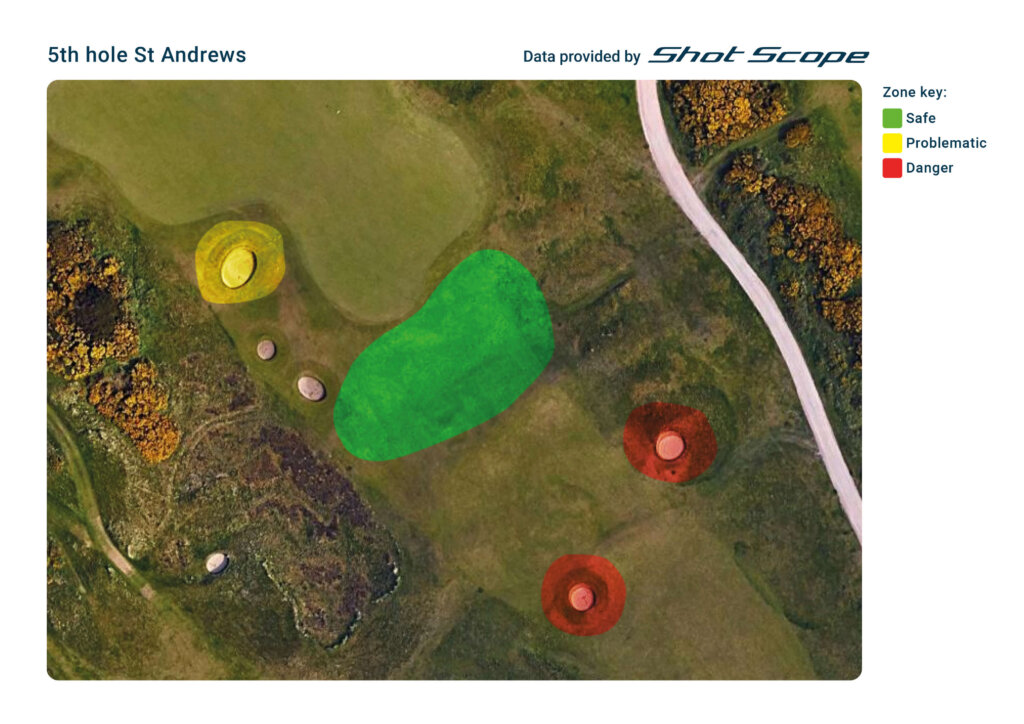
Of the two famous spectacles, the one on the left is more popular than the one on the right. But regardless of which spectacle you may find yourself in, your chance for par drastically decreases to less than 10%. What makes this even more interesting is that the most popular bunker on the 5th hole is actually the one at the left of the green. With a steep slope before the green, lots of golfers are ending up short in the valley.
Fortunately, even if your ball gets sucked into the greenside bunker, your chances are significantly better—38%—at par than if you ended up in either of the spectacles. Longer hitters can take advantage of this by attacking the green and flying the danger of the spectacles in the process.
Hole No. 7 — Par 4, 349 Yards; Avg. Score = 4.60 (Rank = 10)
The 7th hole starts with a classic example of the problems amateur golfers with lower power can face. Indeed, when playing conditions are combined with the fact that many amateur golfers struggle to hit their driver (on average) over 250 yards, many golfers struggle to make the carry to the fairway.
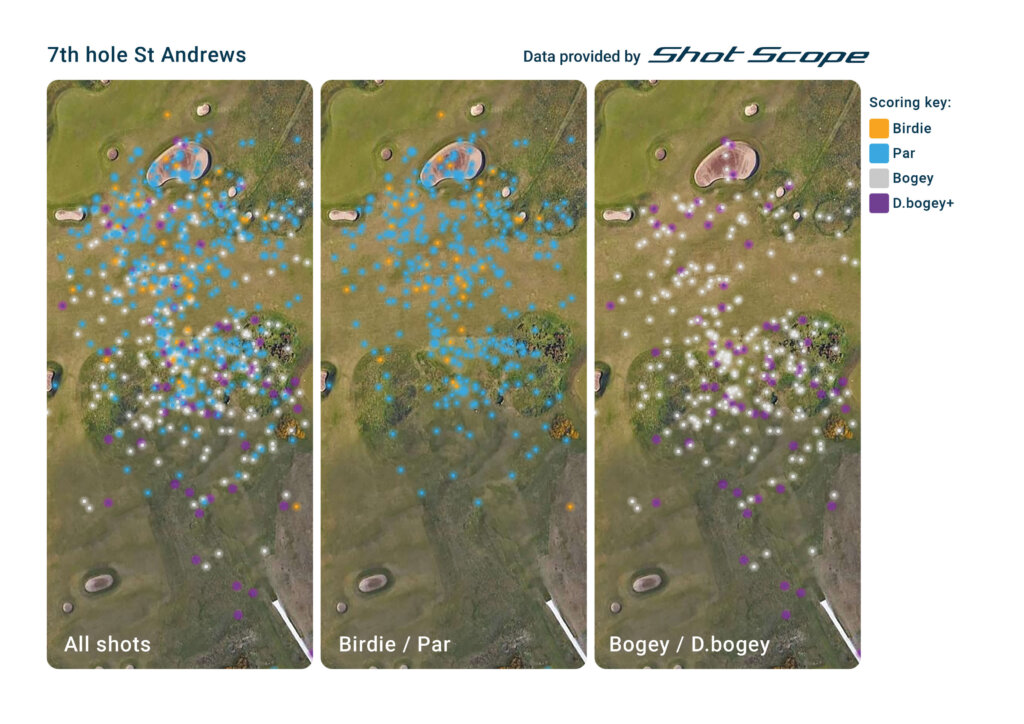
Being forced to start from the less than ideal location brings into play another problem: the Shell bunker. Located approximately 40 yards short of the green, the oversized bunker is where many scores on the 7th have come to die. Indeed, balls that find their way into the Shell bunker result in a 48% chance of leading a double bogey (or worse) and 46% chance of bogey, leaving a meager 6% chance of getting up and down for par.
In sum, look for distance off the tee, and avoid the Shell bunker at all costs.
Hole No. 9 — Par 4, 289 Yards; Avg. Score = 4.15 (Rank = 18)
Rounding out the front 9 is, statistically, the easiest hole on the course. The short par-4 provides an excellent opportunity to lock in a birdie (16% chance), and a very safe chance at par (58%).
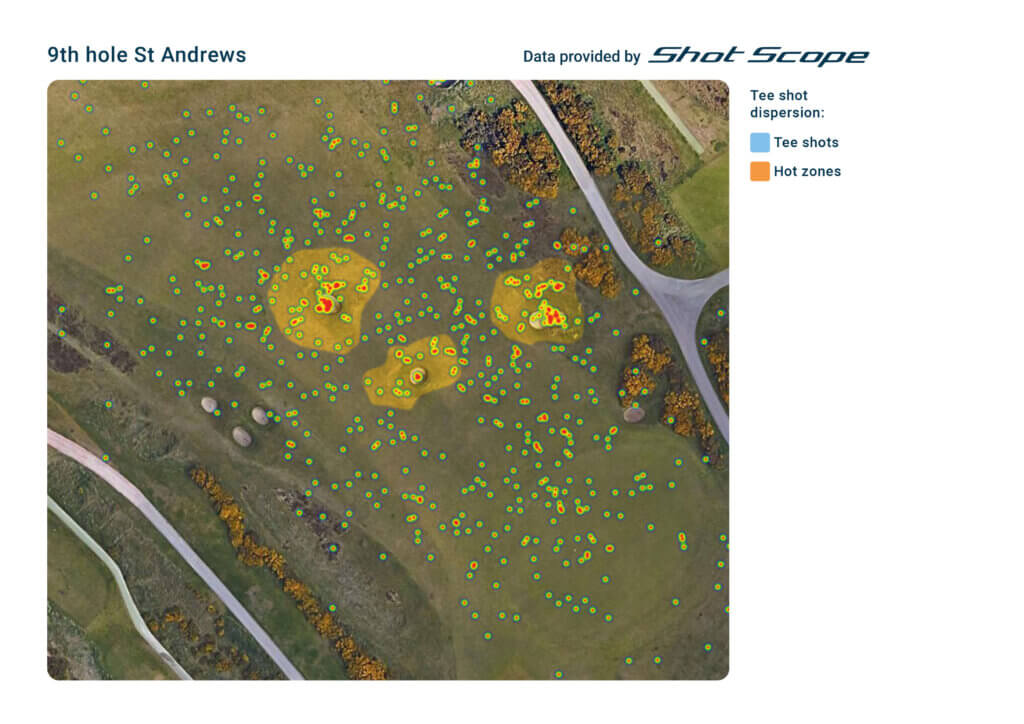
The number of bunkers located on the left side makes the strategy obvious here: favor the right and let it fly. Indeed, the average score from a fairway tee shot is a 4.0 and the right rough is barely punishing, resulting in an average score of 4.1 Meanwhile, averaging scoring from the left rough and bunker is 4.6 and 4.7, respectively.
Having hopefully ended the front-9 on a high note, it’s time to gear up for the more challenging back-9 on the Old Course. With the continued help of Shot Scope, tomorrow we’ll dive into some of the more challenging, as well as famous, holes on the course to make sure you know what to be watching out for once the Open Championship gets kicked off.
Cover Image Via Shot Scope


Blind Ranking The Most Iconic Masters Moments

FIRST LOOK: Titleist Unveils New Vokey WedgeWorks Grind Lineup

New Shot Scope LM1: The Best Budget Launch Monitor Under $200?

Did LIV Golf Finally Get its Big Breakthrough?

FIRST LOOK: Titleist’s New GTS Driver Lineup Spotted on Tour

Streamsong Unveils “Bone Valley”: A Bold New Name and Logo for Its Highly Anticipated Fifth Course

Titleist Introduces Limited-Edition Oil Can Finish on T-Series Irons
FIRST LOOK: Titleist’s New GTS Driver Lineup Spotted on Tour

6 Big Changes Coming to the PGA TOUR
New Shot Scope LM1: The Best Budget Launch Monitor Under $200?

We Played This Old Golf Course Where Thomas Edison Was A Member

Are You MEASURING Your Golf Swing Correctly? (This Can Help)

Zach Johnson Explains Why He Didn’t Pick Bryson DeChambeau for the Ryder Cup

Justin Thomas FIRES Coach before Ryder Cup…Who’s Next?