
Golf Instruction
The Key to Hitting a Low Punch Shot Successfully


Golf would be a lot easier if you could get around the course only hitting one kind of shot.
Of course, that would be pretty boring, so maybe it’s a good thing this game demands so many different shapes and flights to be played well.
If you’d like to add some variety to your game, the low punch shot is a great option to put in your arsenal. And, on this point, there is good news – the low punch shot is one of the easier “alternative” shots to learn.
Take the tips from this article and head to your local range to begin the learning process – let’s get started!
Why Add a Low Punch Shot?
As your game gradually develops and improves, you are going to find yourself less and less willing to give away strokes. For a beginner, it’s no big deal to pitch out of the trees after a bad drive, or to lay up when playing into the wind.
At that point, you are just trying to get the ball safely from tee to green, even if it takes quite a few shots.
Eventually, you’ll want to have shots that can get you out of those situations without wasting a shot. That’s where the low punch shot can come in handy.
Spots where you might be able to use this shot include the following:
1. Windy Conditions
A common use for a low punch shot is when playing into the wind, but you can actually turn to this shot anytime the wind is up – regardless of its direction.

Keeping the ball down will limit the impact the wind has on its flight, making the result of your shot more predictable.
2. A Bad Lie
If you draw a poor lie in the fairway, going with a low punch will help you gain some control over the flight of that shot.
You might not be able to hit your normal full shot while still making good contact, so knowing how to hit a low punch will give you another option to consider.
3. Under an Obstacle
Usually, the “obstacle” in question will be a tree, but it could be other things. For example, if your ball is resting just behind a tree and a normal trajectory would surely cause the ball to hit the tree, you could use a low punch to escape cleanly.
This application of the low punch has the potential to save you a full stroke, as you would likely be pitching out sideways if you didn’t have this shot in the bag.
In addition to the situations listed above, you may also decide to hit a low punch when you want to get the ball close to a back hole location. Instead of flying the ball on a high trajectory all the way to a back flag – and risking going over the green – you can play a punch to land the ball near the middle of the green and run it back to the hole.
This is an advanced play, to be sure, but it’s something you may want to try as your game keeps improving.
Three Essential Keys to the Punch Shot
Hitting a low punch shot is not as difficult as you may currently believe. In fact, once you start practicing this technique, you’ll find that the learning curve is quite short, and you can start trusting the shot on the course pretty soon.
Here are three technical keys to keep in mind as you practice:
1. Middle of Your Stance
Many people believe a punch shot should be played from way back in the stance, but that isn’t quite correct. More accurately, you’ll want to play this shot out of the middle of your stance.
If you put the ball too far back, you’ll make very steep contact and produce a lot of spin – which is probably not what you want.
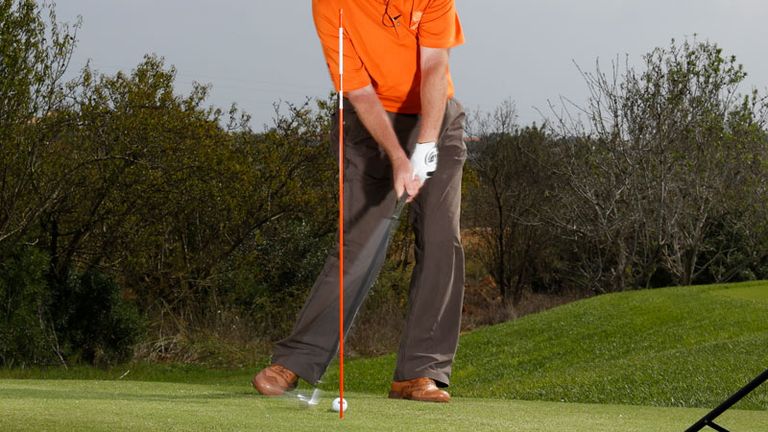
Photo via GolfMonthly.com
Try to keep the ball near the middle of your stance so you can make relatively flat contact and hit a low ball with a modest spin rate.
2. Choke Down on the Club
This is important. You don’t want to be using the whole club for this shot – try using something like a five iron while choking down at least an inch or two on the grip.
This is going to give you extra control over the club, and it will also promote a shorter swing, which is a good thing in this situation.
If you fail to choke down at address, you’ll probably struggle to keep the flight of the ball down low enough to count it as a punch.
3. Quiet Hands at Impact
Finally, you have to keep your hands quiet through the hitting area to hit a quality punch shot. Active hands add loft to the club and spin to the shot, and you don’t want either of those things.
Focus on keeping your lead wrist flat and firm through impact, holding the face steady for a solid strike.
How to Master the Low Punch Shot with David Leadbetter | Golf Tips | Golf Digest
Golf instructor David Leadbetter shows Golf Digest how to take the club back in order to hit the perfect low punch shot with an iron. Transcript There are gonna be times when you’re gonna have to adopt a low punch shot.
Head out for a practice session sometime soon and work on mastering these three points to bring your punch shot to life.
How to Practice a Low Punch Shot
Speaking of practice, you are going to need to work on this shot a bit to get comfortable with how it is played.
On the range, try picking out a target that is shorter than your normal distance with the club you are using. Then, hit punch shots toward that target, working on keeping the ball down and hitting your intended line.
It’s best to practice this shot on real grass rather than artificial turf, if possible. Hitting too many punch shots on the turf could lead to hand and wrist pain as a result of the jolting contact you are likely to make with the practice mat.
Try to make punch shots a regular part of your practice routine, just like some of the other shots you hit. In fact, these are a good way to break up a practice session where you are making one big, aggressive swing after the next.
Take a break from your drivers and hit a few punches with a long iron to tune up this shot – you never know when it may come in handy.


LIV Golf Could Be Facing its Final Chapter

Foresight GC2 Review: A Surprisingly Affordable Launch Monitor From Foresight

FIRST LOOK: Rapsodo MLM2XPRO Adds Putting, Faster Performance & More

FIRST LOOK: Titleist’s 2027 Pro V1 and Pro V1x Are Officially Showing Up on Tour

2026 Presidents Cup Preview: Did Team USA Get It Right?
2026 Presidents Cup Preview: Did Team USA Get It Right?
FIRST LOOK: Rapsodo MLM2XPRO Adds Putting, Faster Performance & More
Foresight GC2 Review: A Surprisingly Affordable Launch Monitor From Foresight
FIRST LOOK: Titleist’s 2027 Pro V1 and Pro V1x Are Officially Showing Up on Tour
LIV Golf Could Be Facing its Final Chapter

We Played This Old Golf Course Where Thomas Edison Was A Member

Are You MEASURING Your Golf Swing Correctly? (This Can Help)
Zach Johnson Explains Why He Didn’t Pick Bryson DeChambeau for the Ryder Cup
Justin Thomas FIRES Coach before Ryder Cup…Who’s Next?
