
Equipment
EQUIPMENT: Sacks Parente Putters: When Premium Materials and Technology Come Together

Without question, putters get the short end of the stick when talking about golf equipment development. While drivers, iron filings and golf balls get 99.8% of the attention so manufacturers can brag about how the ball goes further, straighter, higher, faster and spins more, putters rarely get anything beyond a new coat of paint and a slight change in head weight and shape.
That said, for a putter to be unique, it really has to do something very different to really stand out from the established Anser and Mallet options that are already out there.
View this post on Instagram
Sacks Parente is one of a handful of boutique putter companies that are utilizing real science to develop a putter that provides a measurable, beneficial impact to your short game. Indeed, Sacks Parente allows science and technology to touch every aspect of their clubs, from the club head, through the shaft, and up to the grip.
To explain, the primary aspect setting Sacks Parente’s putters from the rest of the industry is its Ultra Low Balance Point (ULBP) technology.
For those unfamiliar with a golf clubs balance point, simply rest the shaft on your finger until the head and grip are in balance. When you compare a traditional blade and the Series 66 (the model I tested), it is immediately noticeable that the Sacks Parente’s balance point is significantly closer to the putter head.
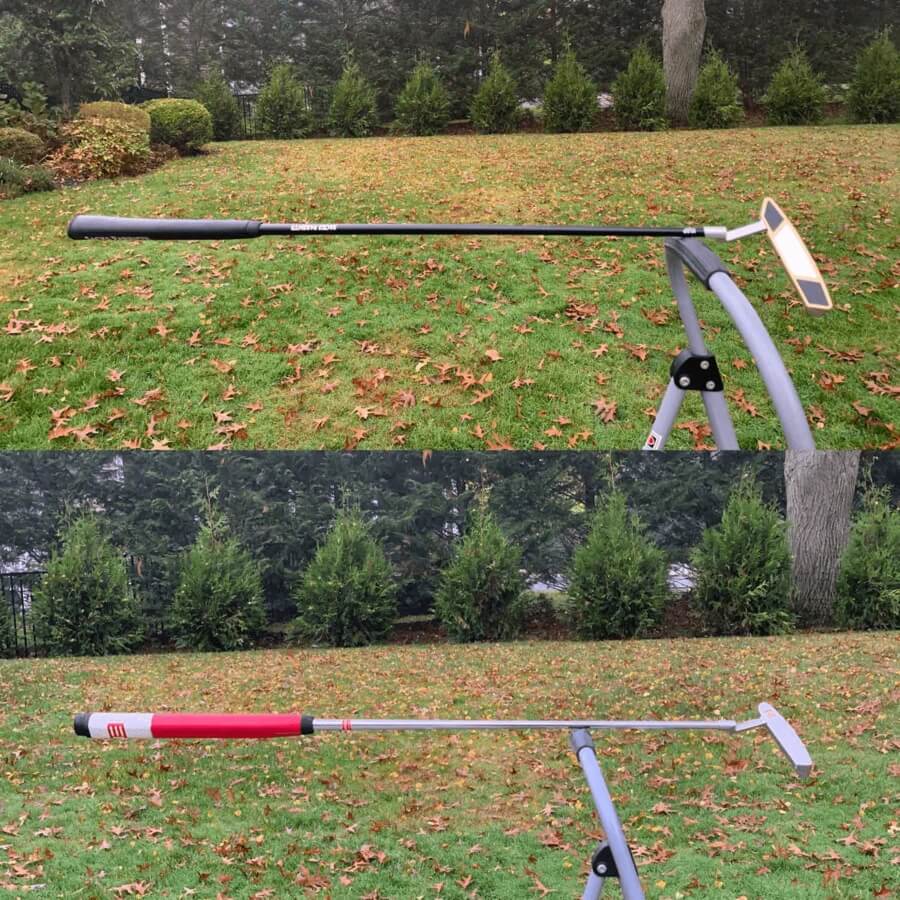
Comparison of Balance Points: Sacks Parente Series 66 with ULBP Technology vs.
Milled Newport 2 Blade Putter with Traditional Metal Shaft
This unique weight distribution enables the golfer to feel the putter head actually traveling through the putting arc. According to Sacks Parente: “[it’s] like the way the anchored putters would let you feel the head, but now in a standard length, and most importantly, without anchoring.”
In addition to the unique feel that promotes more awareness of what the putter head is doing, the ULBP patented system creates a natural putter release, which helps square up the head at impact and releases the putter head, even in high stress situations.
The ULBP technology is accomplished through the use of high quality materials that work in tandem. As mentioned above, Sacks Parente putters combine super-lightweight grips (on average, less than 35 grams) and ultra-light shafts (weighing approximately 1 gram per inch) with milled heads (350-360 grams).
With respect to that last component, Sacks Parente’s next hallmark feature is its Front-weighted Center of Gravity. By maximizing the face-forward CG in their designs—which is accomplished by strategically locating ultra-high density tungsten in the putter head in the Series 66—Sacks Parente reduces harmful sidespin that rear-weighted putters can impart on the ball.
Some gearheads may find this controversial, since CG placement has become a talking point for club manufacturers who want to highlight how “forgiving” their clubs can be. Notably, however, some other major OEMs (cough**TM’s Spider FCG**cough) are finding credibility in Sacks Parente design theories by going against the grain and moving the CG from as far back as possible (a common design feature of mallets) to the front.
Now, there’s no way to sugar coat this, but the Series 66 felt considerably different than my gamer, Newport 2-style putter (which consists of a traditional milled head, standard steel putting shaft and oversized grip). And because weighting is completely different, so it took a few putts before I felt completely comfortable on the green.
But once I adjusted to the different weighting, I noticed that I felt a lot more comfortable and confident with the Series 66. The ULBP technology is real, and you can feel exactly where the putter head is during your stroke, which could be a huge help to anybody you can get jabby or stab at putts. Indeed, the ULBP technology promoted a smooth and fluidness to my stroke, which allowed me to focus on just hitting a solid putt.
The face-forward CG imparts a unique, more solid feeling at impact to. While my traditional putter gives a sensation more akin to hitting the ball, the Series 66 feels more like you’re putting through the ball. I imagine that this is largely due to the face-forward CG working in tandem with the ULBP technology, which further two things: first, that these technologies do, in fact work together, and not independently and, second, that a Sacks Parente putter is, truly, the sum of all its parts.
View this post on Instagram
With respect to its parts, there is no question that Sacks Parente putters can easily go toe-to-toe with boutique, handmade putters that come with four-figure price tags. The Series 66 features a combination of milled 360C brass, milled 7075 aluminum, milled 6061 aluminum, and high density tungsten.
View this post on Instagram
All of the materials are then assembled together and feature tasteful branding, highlighting the putter model, the Sacks Parente insignia and the brand’s promise: Make More Putts.
View this post on Instagram
The technology Sacks Parente packed in the Series 66 enabled me to feel confident when rolling each and every putt. Instead of worrying about keeping the face square, making a clean arc and hitting it on target, I was able to pick my line and simply focus on speed (arguably the most important input while putting). As a result, I often found myself in tap in range, despite dealing with some hairy breaks and slopes.
In fact the only thing I noticed was “missing” from my traditional putter is that I couldn’t lean on the Series 66 when I went to pick up the ball from the hole. But if a Sacks Parente putter can help clean up my short game, then leaning on my putter shaft is something I’m ready, willing and able to sacrifice.
Make sure to check out Sacks Parente’s website and roll some putts with their different models, which can be tested and purchased through Club Champion locations across the U.S.
Cover Image via Instagram


17 Ways to Play Private Golf Courses Without a Membership

Has LIV Golf Just Been Saved by a Mega Investor?

Shot Scope Brings its GPS and Performance Tracking to Apple Watch

Bankruptcy or Bailout…Will LIV Golf Survive?

Can LIV Golf’s Latest Survival Plan Actually Work?
Has LIV Golf Just Been Saved by a Mega Investor?
Shot Scope Brings its GPS and Performance Tracking to Apple Watch
17 Ways to Play Private Golf Courses Without a Membership

We Played This Old Golf Course Where Thomas Edison Was A Member

Are You MEASURING Your Golf Swing Correctly? (This Can Help)

Zach Johnson Explains Why He Didn’t Pick Bryson DeChambeau for the Ryder Cup

Justin Thomas FIRES Coach before Ryder Cup…Who’s Next?