
Equipment
Even the 2017 Distance Report Doesn’t Support Reduced-Distance Golf Balls

On March 5, 2018, the USGA and R&A released the 2017 Distance Report. In sum, the report evaluated driving distance data from 2003 to 2017 from the PGA TOUR, European Tour, Japan Golf Tour, Web.com Tour, PGA TOUR Champions Tour, LPGA Tour, and Ladies European Tour.
In addition, the report examined amateur golfers in the UK from 1996 to 2017. And despite all of the recent claims that the golf ball is going too far, including USGA executive director Mike Davis’ statement that golf ball distances are having a substantial negative impact on the game, the study’s findings were less than supportive for the reduced-distance supporters.
In fact, PGA TOUR Commissioner Jay Monahan, PGA of America CEO Pete Bevacqua, and Titleist (who probably has the most to lose here) all were in agreement that the 2017 Distance Report seems to indicate that golf ball distance isn’t a real issue.
Now, before you continue reading, I’d highly suggest and encourage that you read this article, which discusses the main arguments opposing reduced-distance golf balls. Chief among them: a 20% reduced-flight golf ball would have a substantial negative impact on amateur golfers.
Like, “I’m never playing this game again” levels of frustration.
So after crunching all the data, the 2017 Distance Report revealed:
- The average driving distance on the men’s tours has increased by approximately 2.2% since 2003;
- The average driving distance increase per year was less than 1 yard per year;
- The Web.com Tour saw the biggest increase in average distance during that 14-year time period, increasing 3.6% or 10.6 yards; and
- The average driving distance for average male golfers has only increase 4.0% since 1996, or 8 yards over 21 years
Clearly, the “ball is flying too far” concern is really being overhyped. I mean, when you consider all the improvements in driver technology over the past 14 years (e.g., higher quality shafts, adjustable head-weights, high MOI, low spin, Jailbreak Technology, forged & CNC milled faces), you would think that all the reduced-distance supporters (Mike Davis, Tiger Woods, Jack Nicklaus, and Bridgestone Golf president and CEO, Angel Ilagan) were worried about all the OEMs actually delivering on their driver marketing promises and the golf was actually flying an extra 10 yards each year.
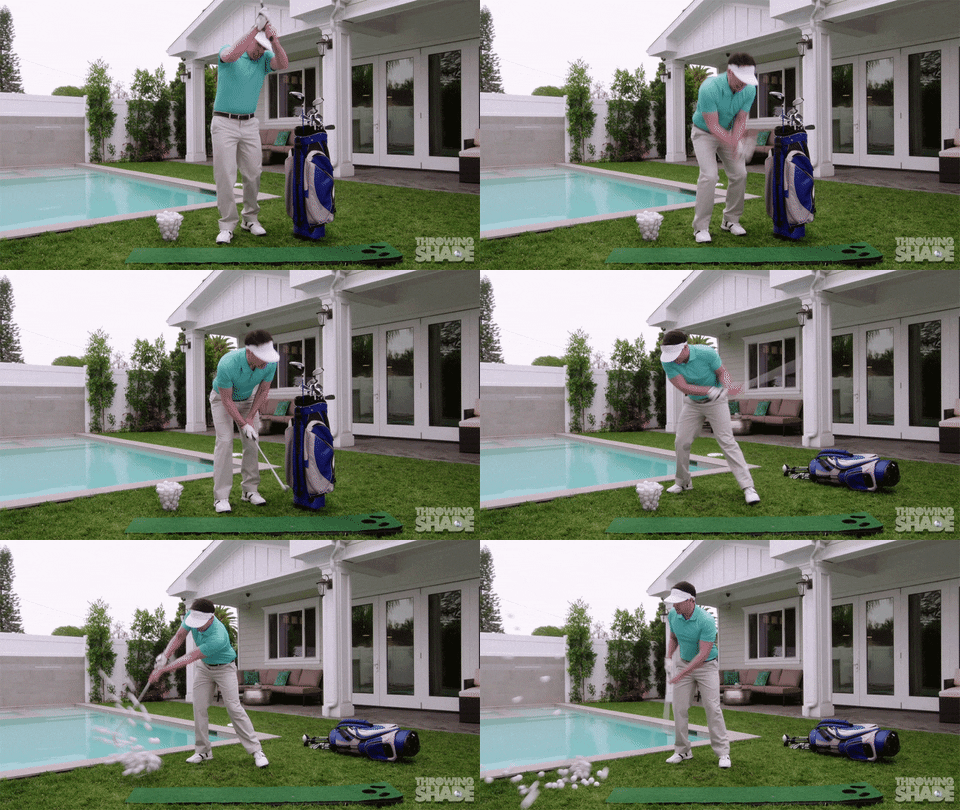
Only adding to the irony, has anybody seen Bridgestone Golf’s most recent ad…
In addition, like we discussed in our previous article, amateur golfers would be severely punished if the USGA/R&A mandated reduced-flight golf balls. Golf is already a very difficult sport, requiring amateur golfers to hit driver’s on Par-3s isn’t going to attract new players or help keep current golfers from quitting.
That said, the fact that the largest increase in distance occurred on the Web.com Tour says something: younger golfers are putting in work in the gym. PGA TOUR Commissioner Jay Monahan has already commented on the fact that the average distance increased in some years while it decreased in others and, instead, there appears to be a stronger correlation between club head speed and distance.
He continued and specifically identified that “increased player athleticism and fitness, physical build of the player, enhancements in equipment fitting and the proliferation of launch-monitoring capabilities” are likely the biggest contributing factors. And that shouldn’t really be a surprise.
In light of all of the equipment restrictions, the OEMs aren’t really allowed to engineer a driver that guarantee that it will go further than anybody else’s. In fact, that’s exactly why “forgiveness”, instead of “distance”, has become the driver marketing buzzword. Furthermore, I’m prepared to go out on a limb and state that the guys on the PGA TOUR have more skill (I mean, they’re on the Tour). As a result, the most logical explanation that really separates the guys on the Tour from the Web.com is the great equalizer: distance.
Once again, I really hope that the decision-makers at the USGA and R&A think about what they’re proposing. I understand that they want to make sure that golf remains competitive, but it shouldn’t come at the expense of every non-professional golfer.
Cover Image via Instagram


LIV Golf Could Be Facing its Final Chapter

Foresight GC2 Review: A Surprisingly Affordable Launch Monitor From Foresight

FIRST LOOK: Rapsodo MLM2XPRO Adds Putting, Faster Performance & More

FIRST LOOK: Titleist’s 2027 Pro V1 and Pro V1x Are Officially Showing Up on Tour

2026 Presidents Cup Preview: Did Team USA Get It Right?
2026 Presidents Cup Preview: Did Team USA Get It Right?
FIRST LOOK: Rapsodo MLM2XPRO Adds Putting, Faster Performance & More
Foresight GC2 Review: A Surprisingly Affordable Launch Monitor From Foresight
FIRST LOOK: Titleist’s 2027 Pro V1 and Pro V1x Are Officially Showing Up on Tour
LIV Golf Could Be Facing its Final Chapter

We Played This Old Golf Course Where Thomas Edison Was A Member

Are You MEASURING Your Golf Swing Correctly? (This Can Help)
Zach Johnson Explains Why He Didn’t Pick Bryson DeChambeau for the Ryder Cup

Justin Thomas FIRES Coach before Ryder Cup…Who’s Next?
