
Courses
Carnage at Carnoustie

From the ramparts of Stirling Castle, one can see the Bridge below where in 1297 William Wallace (Braveheart) slaughtered the English of Edward I in the Battle of Stirling Bridge: he let half the British cross, annihilated them, then went after the remainder. A lot of carnage. About a mile east of the bridge, is a small stream called Bannock Burn. The stream gave its name to the great victory by Robert The Bruce over the English of Edward II in 1313.
During a rest period in that battle, an Englishman named Henry de Bohun rode forward into the space between the two armies and challenged a Scot from the other side to meet him in single warrior combat. This was one of the ways the armies passed the “rest time” between segments of a battle. He was met by the Scot Commander, Robert the Bruce, who warded off de Bohun’s first charge, wheeled around and “cleft his skull with a small battle-axe, the handle of which went to pieces.” de Bohun had his skull split open for his troubles. The Scots are famous for carnage.

A Scottish Battle Axe
Speaking of which, Carnoustie’s 6th hole is 578 yards long. Into the wind. There’s an O.B. fence all the way down the left side. There are pot bunkers in the right center of the fairway that have huge collection areas. Anything between 170 and 280 yards is in a bunker. If you hit short of the bunkers you’ve still got 400+ yards to the green which is surrounded by more pot bunkers and protected in front by a ditch that angles across the fairway. It’s a tough 5.
If you’re game and you want to go for it, there is a very thin 15 yard wide strip on the left between the O.B. and the collection area about 240 yards out. But it’s extremely high risk. This little strip is known as Hogan’s Alley. He hit it every day, with his Driver, on the way to winning the 1953 British Open.
At the time, Hogan was the reigning Masters and U.S. Open Champion. His travel to Scotland, and subsequent victory giving him the “Triple Crown”, put Carnoustie and the British Open on the map.

Hogan’s “Triple Crown” victory parade in New York. Photo via Wikicommons
Back home the Tour Pros had nicknamed Hogan The Hawk for his fierce, sullen concentration and killer instinct. The Hawk loved to practice. He arrived at Carnoustie a couple of weeks early to learn about links golf, practice and get used to the smaller British golf ball. The Scots loved him. At 5’8” and 145 lbs., they called him “The Wee Iceman”.
“I couldn’t wait to get up in the morning, so I could hit balls,” Hogan said. “When I’m hitting the ball where I want, hard and crisply, it’s a joy that very few people experience.” The fact that he could hit that alley virtually every time was testimony to his complete mastery of the golf swing and shotmaking. In appreciation, the Scots renamed the hole “Hogan’s Alley.”
With the encouragement of my old caddy, Malcolm, I tried to hit the alley. That led to O.B. penalties. Trying to play safe led to the bunkers. Playing short of the bunkers made the next shot blind. It’s almost unfair.
At Carnoustie, it’s as if every possible good break, short cut or easy way has been seen and then denied by the addition of bunkers, roughs, dunes or contouring. Over the years, the members have orchestrated that. That’s what Malcolm told me. He had been a member at Carnoustie since he was a teenager. And he was there in ’53 to watch Hogan hit the alley.
After Hogan, when the British Open became “The Open Championship”, Carnoustie fell out of the rotation for many years. The ostensible reason was that there was no world class hotel facility to house the members of the press and other important poobahs who would attend.
The Carnoustie men did something about that. They got some local money together and built the Carnoustie Golf Hotel which is the imposing structure one sees in virtually every shot of the Eighteenth hole. The Open returned in 1999.

Eighteenth tee and Carnoustie Golf Hotel
Naturally, I wanted to stay in the new Hotel: world class and all that. I spoke with the Reservations clerk and was assured that the best room was “very large, with beautiful view of the course”, I booked it.
It was terrible, a little Motel 6 type room with the beds jammed next to the tiny bath and barely enough room to get a suitcase in through the front door. You could not open any door in that room without hitting something! I couldn’t believe it. And now they hold the Open here because somebody built this? It’s hard to understand.
I felt like going down to the front desk and saying, “Look here, I’ve been deceived! This isn’t a four star hotel, it’s a Motel 6!” In fact, I tried to. But when I got to the desk, the desk clerk was just so nice that all the wind went out of my bluster and I couldn’t muster any sort of complaint. I think I inquired meekly about the restaurant’s hours or some such thing. Besides, they wouldn’t have understood the ‘Motel 6’ reference.
In spite of the consternation over the accommodations at the Golf Hotel, the day on the Carnoustie Golf Links was great.
I kept my head down and my thoughts to myself. It was target golf again. Only this time you couldn’t distinguish the targets because they blended right in with the fairways. It’s more than a little unfair. It’s nasty. And, if there’s a wind blowing … well, it’s no wonder they call it “the most challenging golf course in the world.”
The fact is Carnoustie just demands incredible exactitude. It makes perfect sense that Hogan really wowed them here. He had the kind of exactitude that I’m talking about, being able to absolutely and completely control the flight of his ball.
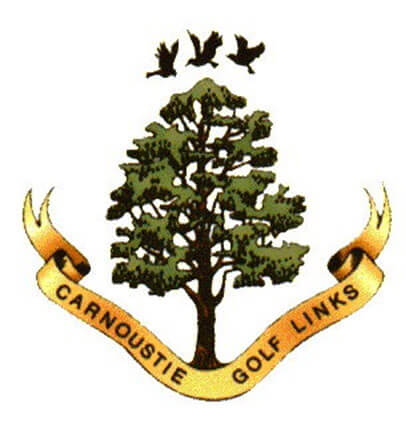
The one thing different at Carnoustie was a tree. It’s startling to see a tree on links land, but there it was right next to the Ninth green. I guess the local folks have the same impression because the tree is the symbol of the course, the main iconic figure in their logo, printed on all their scorecards, stationary, balls, etc.
The number one handicap hole is the 14th, “Spectacles”.
So named for the two eyeball shaped bunkers sticking up in the middle of the fairway and obscuring the green. It looks just like a “Kilroy was here” face. They’re a hundred yards from home, making it a blind artillery lob for your second.
For the second, old Malcolm gave me the two iron and said, “you have to hit a perfect shot between the spectacles. Anything else is trouble.” I looked up at him after a waggle or two thinking ‘how perfect?’ and he said sternly, “between the spectacles, lad.”
I hit what felt like a good shot, though it was leaking right a little as it disappeared over the right eyeball. I looked at Malcolm for a sign. He just pursed his lips and smiled oddly. ‘Boy’, I thought, ‘he’s leading me to the slaughter. There’s blood all over the place and the old Scot loves it.’
Just past the spectacles, you begin to see the green, which is actually part of a huge double green that runs away from you, so if you do manage to carry it, chances are that you’ll then roll so far down towards the other hole as to make two putting problematic.
In front of the green there’s a large collection area for a nasty bunker that guards it like a deep moat. There’s an embankment on the left with long frog hair rough and a hidden trench bunker on the right. You can’t run it in anymore the way Malcolm said they used to because of the new front bunker, you can’t play short, you can’t even plan on playing into the bunkers because you may not get out. You have to hit the green from two hundred plus yards out. Blind. And stick it or bleed. Unfair? Nasty? Now I’m thinking mean spirited. Or is it just plain bloodlust?
The Eighteenth, “Home”, is the Jean Van der Velde hole. In 1999 the Frenchman was leading by 3 on the last tee and all he needed was a 6 to win The Open. He drove into the right rough, then hit the grandstands with his second. The ball bounced backwards into deeper rough. The fescue strangled his third and it went splash into the burn. He drops for four. Hits into a green side bunker five, out in six and one putts for 7 and a playoff with Justin Leonard and the eventual winner, Paul Lawrie. Ugh, the pain. The anguish. The comedy. I maintain that it was the spirit of Robert The Bruce that did in poor Jean that day: if not the English, then let’s kill the French! Have at ‘em, lads. The Scots are famous for their carnage.
It was loads of fun, all of it: every shot, every wind blown double bogey, and every cursed moment in the bunkers. After the round, Malcolm invited us to have a pint in their Clubhouse. We politely demurred because we had checked out of Hell House early and had to make tracks down to Fife.


LIV Golf Could Be Facing its Final Chapter

Foresight GC2 Review: A Surprisingly Affordable Launch Monitor From Foresight

FIRST LOOK: Rapsodo MLM2XPRO Adds Putting, Faster Performance & More

FIRST LOOK: Titleist’s 2027 Pro V1 and Pro V1x Are Officially Showing Up on Tour

2026 Presidents Cup Preview: Did Team USA Get It Right?
2026 Presidents Cup Preview: Did Team USA Get It Right?
FIRST LOOK: Rapsodo MLM2XPRO Adds Putting, Faster Performance & More
Foresight GC2 Review: A Surprisingly Affordable Launch Monitor From Foresight
FIRST LOOK: Titleist’s 2027 Pro V1 and Pro V1x Are Officially Showing Up on Tour
LIV Golf Could Be Facing its Final Chapter

We Played This Old Golf Course Where Thomas Edison Was A Member

Are You MEASURING Your Golf Swing Correctly? (This Can Help)
Zach Johnson Explains Why He Didn’t Pick Bryson DeChambeau for the Ryder Cup
Justin Thomas FIRES Coach before Ryder Cup…Who’s Next?
