Courses
Turnberry, Out of the Rota!
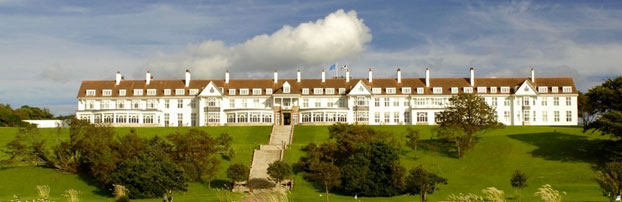
It sat on top of the hill like a beautiful angel, pure and white, arms outstretched, warm, smiling as it welcomed the wounded.
And the wounded came. During both World Wars. It was known as RAF Turnberry. What had been a golf hotel was converted to a military hospital and used mainly to succor wounded Royal Naval personnel who were flown in for hospitalization. The locals like to say that the Germans never bombed the place out of respect for the wounded.
The grounds of the old golf courses were converted to an RAF air base. B-24 Liberators flew anti-submarine missions from here. Barnes Wallis’s dam busting bouncing bomb flew training runs from here. RAF Bristol Beaufighters trained here.
The old main runway is still here, a little torn up and crumbly, but still here. It runs from the shore directly inland toward the hotel/hospital. It was used for parking when The Open Championship was played here.
After the war, the golf courses were remodeled, the hospital went back to being a golf hotel, and the old RAF air field was left to the devices of Mother Nature. It’s eerily evocative, this broken down runway from long ago set out between the golf courses. You can almost hear the drone of the planes approaching from over the Firth of Clyde and bearing down on the strip as they ferry in the wounded.
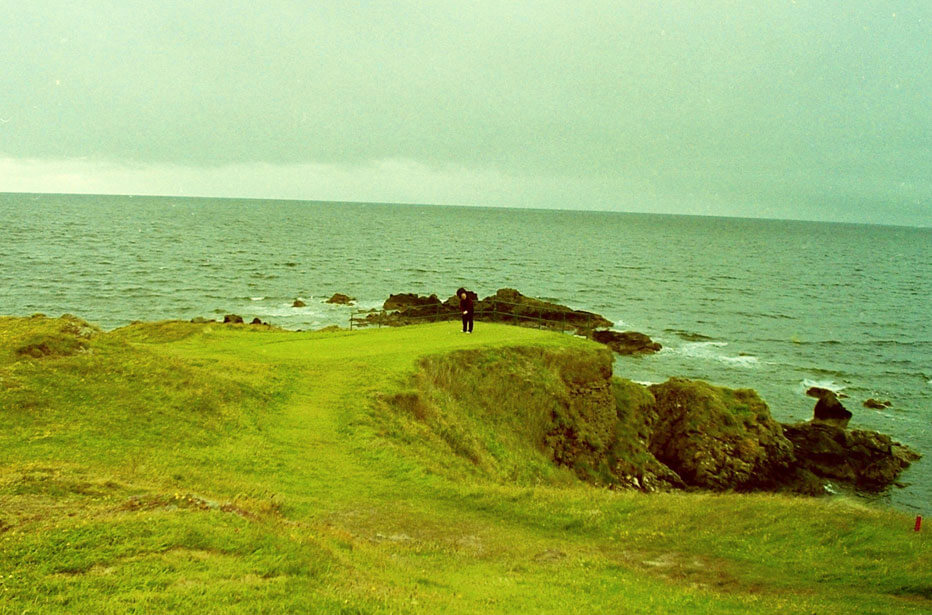
Ninth Tee, Ailsa Course, Turnberry. The fairway is two hundred yards away, over the rocks and up the hill. And you can’t see it. You have to air mail it up there.
The Championship Ailsa Course, the one that used to be a regular host of The Open Championship, is evocative as well. I say “used to be” because last year the property was bought by Donald Trump and renamed “Trump Turnberry”. In the run up to the Presidential election, Trump’s repeated racially biased statements triggered a re-evaluation by members of the Royal & Ancient and their decision that they’d rather not be associated with Mr. Trump. They therefore have rescinded the 2020 invitation to Turnberry to host the tournament.
So much for golf as a refuge from politics…
This is a monumental shame because the Ailsa Course is the most beautiful of all the courses in the Open rota. It’s hauntingly beautiful. Built on a promontory around an old lighthouse and the ruins of Robert the Bruce’s childhood castle, it effortlessly follows the natural topography of the beaches, rocks and dunes to produce long green rivers of holes.
There’s much more grass and fairway here than at other Links courses, likely due to the updating and remodeling after the war. And the rough is not quite so unforgiving. You can see trouble before you hit your shot, so you don’t feel like you’re being surprised all the time by the hazards.
The holes look like they’ve been meticulously sculpted out of the soft terrain, so smooth and green and esthetically pleasing are they. The course just says, “Play Me!”. The holes flow down gentle rills and up and over pleasingly shaped dunes, along the rocky coastline where at one point you can see a rock formation silhouette of ‘Robert The Bruce’ looking back at the ruins of what was once his castle.
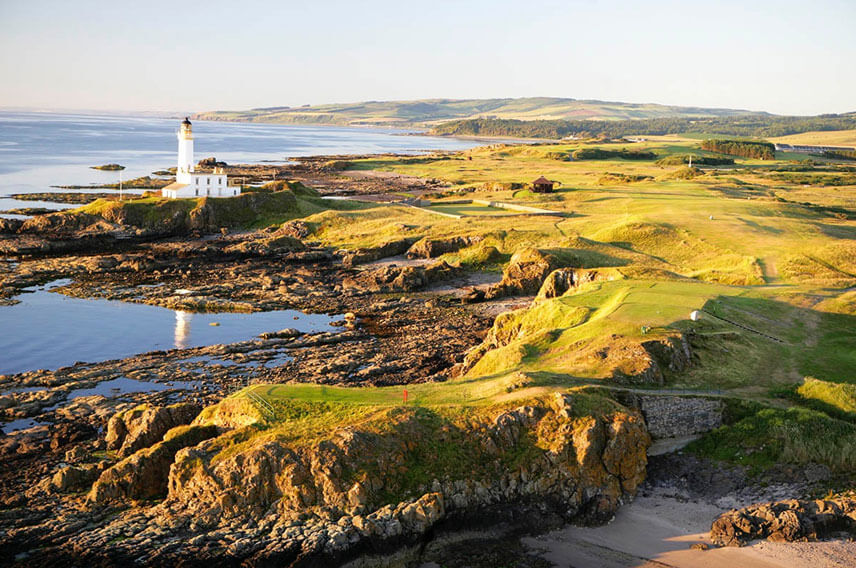
What the Ninth looks like from the back side.
The whole course generates a warm and cozy feeling. It’s almost protective. Which is not to say that it can’t be horrendously difficult: when the wind blows, all bets are off. It’s just that the looks of this course are so warm and friendly that it begs for your best golf.
The Hotel sits high up on a hill overlooking the courses, the lighthouse and the castle ruins. And the old air strip. It’s a beautiful and elegant facility.
Our first day at Turnberry we played the Kintyre Course and that experience was entirely forgettable. Except for the fact that the Caddy Master had given us two fairly inexperienced loopers. The next morning I sought him out and told him, politely, that that was unacceptable and that for the round on the Ailsa, I wanted his two best men. “They have to know the yardage, be able to read the greens and be able to club my wife,” I told him in terse declarative sentences. “She’s a 14.” “Oh, you’ll have to go up to Troon for that,” he replied without batting an eyelash.
It made me laugh. Then he laughed, and we were on friendly terms. He gave me his two best men, Frank and Tommy. I tell you, it was some of the best money I ever spent. I learned more from Tommy about reading greens in that one day than I had learned in the previous 40 years of competitive golf. What an awakening.
I doubted Tommy’s read on the first green when he called a twelve footer “one ball to the right”. It looked like a foot to the right to me, but he was so definitive in the call I thought, ‘okay, let’s play it a ball out and see what happens’. It ran smoothly and dropped right into the center of the cup. Whoa. I looked at it again and continued to see a foot of break.
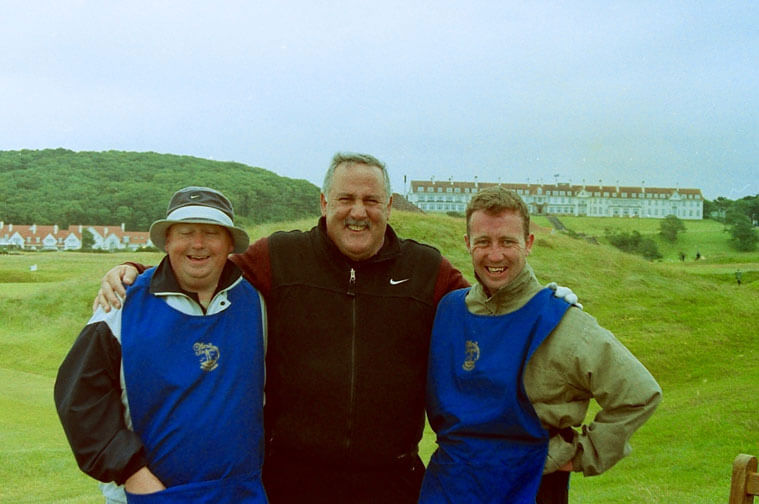
Frank, a natural comedian, and Tommy, the Great Green Reader.
We talked about putting throughout the round. On all but the shortest putts, I want it to die in the hole. Tommy agreed. My problem was that I’d add six inches to any break that I saw because when I was learning as a Junior, the standard maxim was: ‘don’t miss low, the low side is the sucker side’. So I’d see a break, add to it, and wind up with a general idea of how the putt would run instead of the actual specific line.
This wouldn’t do for Tommy. He wanted the exact line for the entire putt. Every inch of it. He got me to visually trace the path of the putt, foot by foot, across the surface, all the way into the hole. That made me ‘see’ the break as it occurred. When I miscalculated in the tracing, and could see that it wasn’t going to be enough, or that it was going to be too much, I’d come back to the ball and start over again.
Then, it was just a simple matter of rolling the ball on that line. That I could do. Tracing the line made an enormous difference for me. From then on I just rolled it on the line I had traced, or where Tommy indicated. I sank basically everything I looked at: a fistful of five to ten footers for pars, plus 5 or 6 real ropes.
The technique has become a natural part of my putting. I do it on virtually every putt, and I continue to sink a fairly high percentage of them. The idea also translates to other aspects of the game: be exact, be precise as to what you see and what you intend. Remember Tommy’s words: “Don’t Guess! See it! Actually see it!”
One of the really charming touches that the Hotel provides is the Piper who signals the close of the playing day by ceremonially marching up the hill from the Clubhouse to the Hotel, piping all the way. You’re sitting there on the porch enjoying the sunset with a fine single malt scotch in one hand, a real Cuban Romeo y Julieta in the other, and here he comes playing “Scotland The Brave.” It’s enough to make your stomach flutter.
Perfect end to a perfect day. Great Caddy. Great Course. Great Turnberry.
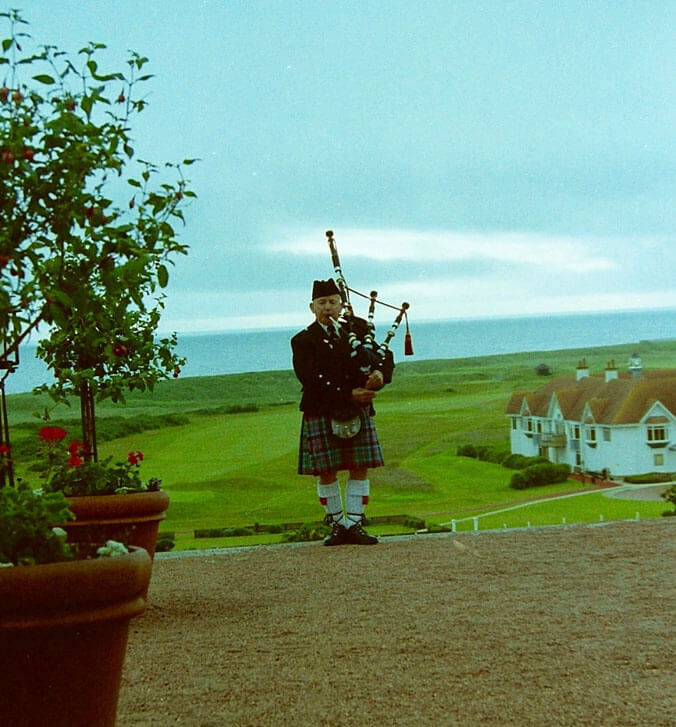
The close of the playing day, signaled by the evening Piper. The Firth of Clyde and 18th hole of the Ailsa Course behind him. Clubhouse to the right.


Foresight GC2 Review: A Surprisingly Affordable Launch Monitor From Foresight

FIRST LOOK: Rapsodo MLM2XPRO Adds Putting, Faster Performance & More

FIRST LOOK: Titleist’s 2027 Pro V1 and Pro V1x Are Officially Showing Up on Tour

2026 Presidents Cup Preview: Did Team USA Get It Right?

Turning Stone: The Northeast’s Most Underrated Golf Destination
2026 Presidents Cup Preview: Did Team USA Get It Right?
FIRST LOOK: Rapsodo MLM2XPRO Adds Putting, Faster Performance & More
Turning Stone: The Northeast’s Most Underrated Golf Destination
Foresight GC2 Review: A Surprisingly Affordable Launch Monitor From Foresight
FIRST LOOK: Titleist’s 2027 Pro V1 and Pro V1x Are Officially Showing Up on Tour

We Played This Old Golf Course Where Thomas Edison Was A Member

Are You MEASURING Your Golf Swing Correctly? (This Can Help)
Zach Johnson Explains Why He Didn’t Pick Bryson DeChambeau for the Ryder Cup
Justin Thomas FIRES Coach before Ryder Cup…Who’s Next?