
Golf Instruction
Decoding Ben Hogan’s Wrist Supination for Better Ball Striking

Ben Hogan is one of the best ball strikers of all time.
A legend of the game, Hogan is remembered for his incredible ability to hit the ball solidly time after time.
While it would be nearly impossible for anyone to exactly replicate the quality of his swing and the consistency of its results, we can learn from what he demonstrated – as well as what he said.
Wrist supination is a topic that regularly comes up when discussing Hogan’s swing.
We’d like to use this article to look at this topic in basic, general terms, hopefully making the underlying concept easy to understand and apply. We have no aims of helping you become the next Ben Hogan – you’re on your own on that one – but we’d like to offer some advice that you can use to move the quality of your ball striking in the right direction.
The Basic Concept
The topic of wrist supination in golf is one that has been discussed – and debated – endlessly. We aren’t here to get into that debate in any meaningful way. Instead, we would like to deliver some helpful advice so you can improve your ball striking.
At the core of this topic is getting your lead wrist (the left wrist for a right-handed golfer) into a good position at impact.
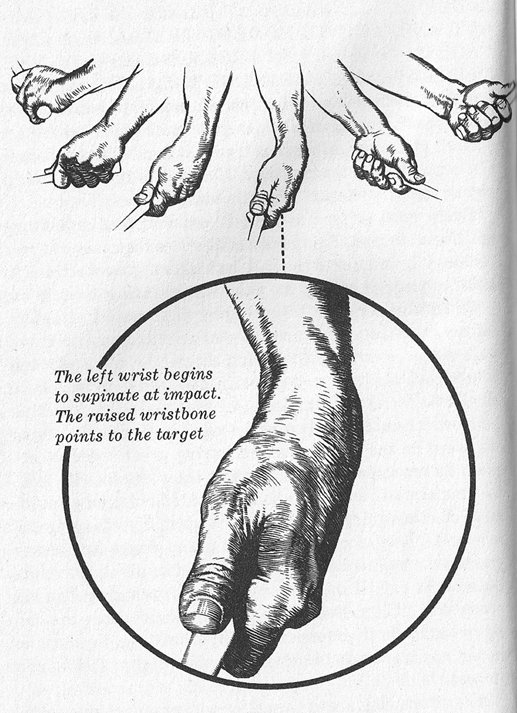
By a ‘good’ position, we mean a flat or slightly bowed position when you strike the ball. This is the opposite of the cupped position that many golfers seem to find themselves in when they make contact.
If you are able to reach a flat or bowed position with that lead wrist when you hit the ball, the quality of your strikes should be improved dramatically.
Many Golfers Struggle with This
If you were to look up and down the driving range on a busy Saturday at your local course, you’d see a lot of players with their lead wrist cupped at impact.
This is a major cause of ball striking struggles for the average player, yet many don’t even know that it’s a problem.
So, why do so many players wind up with a cupped wrist at impact? There are a couple of underlying issues that could be to blame.
Problem #1 – Overactive Hands
Ideally, the golf swing would be largely controlled by the big muscles in the body, with the hands and wrists playing a relatively minor role. This kind of swing can be powerful and repeatable, with the club falling into the same position over and over again.
However, most golfers don’t execute this kind of swing, with the average player relying more on his or her hands and wrists to move the club.
If you are using your hands too actively in the swing, you may be ‘casting’ the club from the top of the swing, which is a move where your hands send the clubhead down toward impact before your body has had a chance to turn toward the target.
The end result of this move is often a slice, and your lead wrist will probably be cupped at impact. Quieting the hands and turning more effectively with your lower body in the downswing will go a long way toward solving this problem.
Problem #2 – Extremely Strong Grip
If you use a very strong grip to hold onto the club – with the left hand turned well to the right as you look down at address (for a right-handed golfer), you will be starting in a cupped position. So, it’s pretty easy to return to a cupped position if you start off in that spot.

Image via TheGratefulGolfer.com
That doesn’t mean that all players with a strong grip will be cupped at impact, but you need to make sure the rest of your swing mechanics allow you to get into a better position when you strike the ball.
Generally speaking, players who use a strong grip have to make an excellent lower body turn through impact to keep the wrist from cupping. If you aren’t a player that uses an aggressive body turn in the swing, you may be better off by switching to a weaker grip position.
If you are trying to improve on how your wrists work at impact in your swing, start by thinking about the two points above and how they apply to your current technique.
Make Use of Chipping Practice
It’s hard to feel the position of your lead wrist at impact during a full swing, simply because the moment of impact comes and goes so quickly. Things slow down when you chip, however, so this is a great area to notice what a good wrist position feels like and you can gradually work toward finding that same position in your full swing.
As you practice your chipping while working on your lead wrist position, you’ll quickly notice that you can’t have a firm or flat left wrist when the handle of the club is behind the ball at impact.
If the handle of the club is hanging back, your wrist is almost certain to be cupped.
So, for chip shots, start with your hands just a bit in front of the ball at address, and make sure they get back to that point at impact. There are more dynamics involved in the full swing that complicate things a bit, but the general concept is the same.
Don’t Lose the Big Picture
It’s important to have your wrists working properly at impact, but it may be even more important to keep the big picture of your swing in mind. That means paying attention to fundamentals like balance, body rotation, swing plane, and on and on.
If you focus too specifically on one specific move, like wrist supination, you may find yourself drifting away from any past progress you have made on your swing.
Everything needs to come together into a complete package for you to reach your goals on the course, so don’t let one specific piece take up too much of your time and attention.


Ocean City Golf Trip Guide: Great Courses, Affordable Golf & A Beach Town Vibe

LIV Golf Could Be Facing its Final Chapter

Foresight GC2 Review: A Surprisingly Affordable Launch Monitor From Foresight

FIRST LOOK: Rapsodo MLM2XPRO Adds Putting, Faster Performance & More

FIRST LOOK: Titleist’s 2027 Pro V1 and Pro V1x Are Officially Showing Up on Tour

2026 Presidents Cup Preview: Did Team USA Get It Right?
FIRST LOOK: Rapsodo MLM2XPRO Adds Putting, Faster Performance & More
Foresight GC2 Review: A Surprisingly Affordable Launch Monitor From Foresight
FIRST LOOK: Titleist’s 2027 Pro V1 and Pro V1x Are Officially Showing Up on Tour
LIV Golf Could Be Facing its Final Chapter

We Played This Old Golf Course Where Thomas Edison Was A Member

Are You MEASURING Your Golf Swing Correctly? (This Can Help)
Zach Johnson Explains Why He Didn’t Pick Bryson DeChambeau for the Ryder Cup

Justin Thomas FIRES Coach before Ryder Cup…Who’s Next?