
Distance
Determining How High to Tee Your Driver Shots

In golf, as in life, it is often the small details that are the most important. If you can get the little details right, it seems that the big things take care of themselves.
That is the case when it comes to tee height for your driver. While you might think at first that hitting good drives can’t be as simple as using the right tee height, this seemingly small point is far more important than it appears. Sure, you still have to make a good swing in order to hit a long drive right down the middle, but tee height can play a big role in this equation.
Of course, once you understand that tee height is an important variable in your driver game, there is only one question that will follow – how high should the ball be teed for the average drive? Unfortunately, the answer to that question is rather complicated, as it depends on a number of variables.
Hopefully we can provide you with some clarity on this point.
Relative to Your Club
You aren’t going to be able to find a universal measurement in inches or centimeters for tee height on your drives, because everything is relative to the driver that you use.
Driver heads come in a variety of shapes and sizes, and the ideal tee height for you is going to depend in part on your club. Therefore, when talking about tee height, it is always best to think in terms of the driver itself. For instance, you may choose to tee the ball so that it is halfway above the top of the driver when the club is grounded at address.
This kind of ‘measurement’ is far more useful than just a number, as you can easily see the ball positioned on the tee next to your club.
The Need to Hit Up
Tee shots struck with your driver are unique in the game of golf as they are basically the only shots that you want to hit up on intentionally. The rest of the game is built on hitting down through the ball, but that is not ideal when talking about the driver.
To hit great drives, you want to hit up through impact – which means the ball needs to be teed up high enough to make that happen.
As a starting point, you should be teeing the ball up at least slightly above the level of the sweet spot of your driver. If the ball is below the sweet spot at address, you will have no chance to strike the sweet spot without taking a divot – and you certainly don’t want to be taking a divot on this shot.
Even if the ball is even with the sweet spot, you will have to have the sole of the club on the turf at impact, which is a difficult position to reach consistently. Therefore, teeing the ball up at least a little bit higher than your sweet spot at address is a great starting point for the tee height conversation.
Experimenting
There are simply too many variables involved in this discussion to come to a conclusion on a ‘best’ tee height for all golfers. Not only are there a number of different drivers on the market to account for, but there is also the matter of the unique nature of each golfer’s swing.
The way you swing the club is unique to you, and that means that you have to find a tee height which compliments your technique.
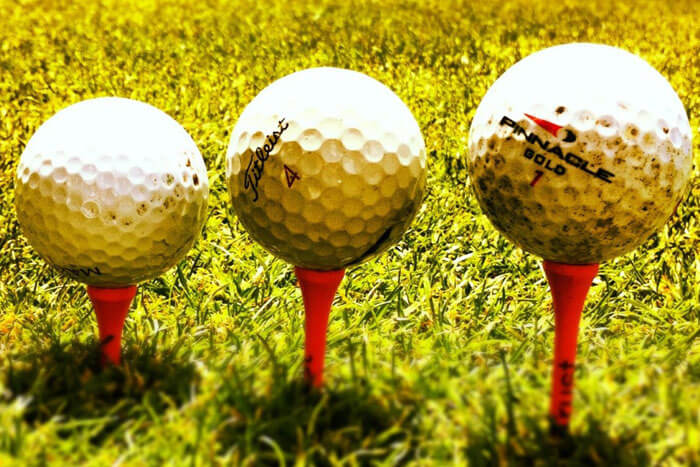
The best way to find the right tee height? Practice, of course.
Spend time hitting drivers on the driving range while experimenting with a number of different heights. Keep an open mind early in the process, as you never know when the results might surprise you.
After a couple of practice sessions filled with low, medium, and high tee heights, you should be able to determine which height is best for your standard drive.
Dealing with Conditions
As you know, golf is a game that is played outdoors in all kinds of weather conditions. Variable conditions are part of what makes golf so interesting, but they also add a significant degree of difficulty to the game. As it relates to tee height, you need to be sure you are thinking about conditions when you decide how far to slide your tee into the turf.
On a calm, peaceful day, you are going to want to send the ball as high up into the sky as possible. Teeing the ball high will help you to hit it high, and you will also see a decreased backspin rate in most cases – which is going to help you get maximum roll when the ball lands. If distance is your goal and the weather is cooperating, tee it high and let it fly, as they say.
The story, of course, is different when the weather starts to kick up. If you are playing on a windy day, a lower tee height is likely to be your friend. By teeing the ball down lower, you can use less of the effective loft on the face of your driver, resulting in a low shot that avoids some of the breeze as it flies down the fairway. You are going to give up some distance when teeing the ball lower, but the control that you gain will be more than worth it on a blustery day.
While tee height is an important piece of the driving puzzle, it is also a highly-individual issue. Some players love the play the ball low to the ground with the driver, while others like to tee it up high so they can swing up aggressively through impact.
The right tee height for you is the one that makes you confident and leads to a reliable and useful ball flight. Don’t be afraid to experiment with various tee heights, make sure to adjust for conditions as necessary, and trust what you learn in practice to guide your decisions out on the course.



Ocean City Golf Trip Guide: Great Courses, Affordable Golf & A Beach Town Vibe

LIV Golf Could Be Facing its Final Chapter

Foresight GC2 Review: A Surprisingly Affordable Launch Monitor From Foresight

FIRST LOOK: Rapsodo MLM2XPRO Adds Putting, Faster Performance & More

FIRST LOOK: Titleist’s 2027 Pro V1 and Pro V1x Are Officially Showing Up on Tour
FIRST LOOK: Rapsodo MLM2XPRO Adds Putting, Faster Performance & More
Foresight GC2 Review: A Surprisingly Affordable Launch Monitor From Foresight
FIRST LOOK: Titleist’s 2027 Pro V1 and Pro V1x Are Officially Showing Up on Tour
LIV Golf Could Be Facing its Final Chapter
Ocean City Golf Trip Guide: Great Courses, Affordable Golf & A Beach Town Vibe

We Played This Old Golf Course Where Thomas Edison Was A Member

Are You MEASURING Your Golf Swing Correctly? (This Can Help)
Zach Johnson Explains Why He Didn’t Pick Bryson DeChambeau for the Ryder Cup
Justin Thomas FIRES Coach before Ryder Cup…Who’s Next?


The issue of tee height is MASSIVELY important. For the average player it can make a lot of difference. It is all about consistency and finding what is right for you and sticking with it. Just my humble opinion but once you have found the right height you should stick with it always, whether you are down wind, head wind or cross wind. Experiment with “castle” tees and find what is right for you. I use low yellow castle tees of 25 mm above the ground. A golf ball is 42 mm so the middle is 21 mm That gives… Read more »