
Club Selection
Golficity Data Dive – Approach Shots from Outside 100 Yards

This article is another installment in the Golficity Data Dive series, which is based on Shot Scope data analyzing more than 18 million shots recorded on more than 40,000 courses around the world. Armed with an abundance of data from amateurs golfers of all different skill levels, Shot Scope has identified some trends and patterns that higher handicap golfers often fall victim to and, with a few simple strategy changes, can help them play better, score lower and, as a result, have more fun while out on the course.
Matthew Wolff’s win at the 3M Open in Minnesota has garnered lots of attention. While Wolff’s incredibly unique swing and winning, 26-foot eagle putt have been the primary takeaways, one of the main factors that led to Wolff’s victory was his strokes gained (SG) approach performance (i.e., shots that are not from the tee on par-4 and par-5 holes, around-the-green or putts).
This is largely because, in contrast to most amateur golfers, the pros know exactly how far their iron shots go with full swings, ¾ swings, half-swings, etc.
In this regard, one of Shot Scope’s invaluable features is that it provides users with their true, GPS-tracked club distances, which can then be used to help make better decisions and, ultimately, shoot better scores.
Knowing your distances is particularly important in light of the fact that Shot Scope data reveals that 72% of danger is at the front of the green (usually a sand bunker or water hazard), whereas there’s only 28% at the back.
Simply put, missing long is often significantly less dangerous than missing short.
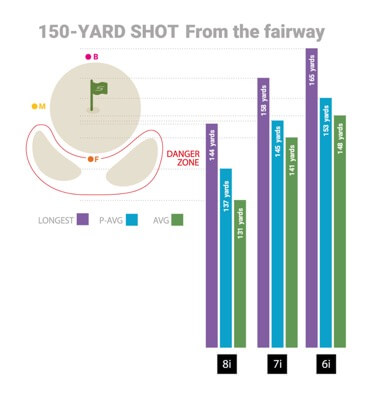
Using the club distances and hole pictured above, if this golfer were to hit their 8 iron (which, when well struck, should put them in the middle of the green), his distance average and performance average show that he would likely end up in the danger zone at the front of the green. Accordingly, the same golfer would benefit from playing a 7 or 6 iron and eliminate the chance of landing in the danger.
Want another reason why clubbing up is probably a good idea: Greens In Regulation.
For those unfamiliar, a “GIR” is achieved when the ball rests on the putting surface and the number of strokes taken is at least two fewer than par (i.e., by the first stroke on a par 3, the second stroke on a par 4, or the third stroke on a par 5).
Notably, GIR is, arguably, the most important stat for lowering your score.
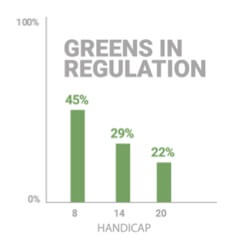
Indeed, Shot Scope data reveals a significant decrease in GIR percentage between an 8 and a 14 handicapper largely due to the fact that a 14 handicapper generally doesn’t hit it quite as far and can’t reach some holes in regulation.
In contrast, the 8 handicapper, generally, hits it further and more effectively manages their club distances, thereby resulting in a much higher GIR percentage.
In sum, if you happen to be struggling with your approach shots from over 100 yards and are committed to lowering your scores, considering taking one more club than you think you need (except for those holes where the real trouble is behind the green).
While it’s certainly going to be a little humbling at first to put your 8 iron back in the bag and, instead, go with the 7 iron, by including a little extra cushion for error, you’ll likely find yourself on the green (and achieving more GIRs) or, in the worst case, in a safer place that should present an easier up-and-down opportunity.
Player data and graphics courtesy of Shot Scope


LIV Golf Could Be Facing its Final Chapter

Foresight GC2 Review: A Surprisingly Affordable Launch Monitor From Foresight

FIRST LOOK: Rapsodo MLM2XPRO Adds Putting, Faster Performance & More

FIRST LOOK: Titleist’s 2027 Pro V1 and Pro V1x Are Officially Showing Up on Tour

2026 Presidents Cup Preview: Did Team USA Get It Right?
2026 Presidents Cup Preview: Did Team USA Get It Right?
FIRST LOOK: Rapsodo MLM2XPRO Adds Putting, Faster Performance & More
Foresight GC2 Review: A Surprisingly Affordable Launch Monitor From Foresight
FIRST LOOK: Titleist’s 2027 Pro V1 and Pro V1x Are Officially Showing Up on Tour
LIV Golf Could Be Facing its Final Chapter

We Played This Old Golf Course Where Thomas Edison Was A Member

Are You MEASURING Your Golf Swing Correctly? (This Can Help)
Zach Johnson Explains Why He Didn’t Pick Bryson DeChambeau for the Ryder Cup

Justin Thomas FIRES Coach before Ryder Cup…Who’s Next?
