
Golf Instruction
Golficity Data Dive – Improve Your Accuracy Off the Tee with Smarter Targets

This article is another installment in the Golficity Data Dive series, which is based on Shot Scope data analyzing more than 18 million shots recorded on more than 40,000 courses around the world. Armed with an abundance of data from amateurs golfers of all different skill levels, Shot Scope has identified some trends and patterns that higher handicap golfers often fall victim to and, with a few simple strategy changes, can help them play better, score lower and, as a result, have more fun while out on the course.
Driving distance has certainly become one of the most focused on stats on the PGA Tour and, to some degree, rightfully so. Indeed, the Strokes Gained metric routinely supports why the longest guys off the tee—Brooks Koepka, Rory McIlroy and Dustin Johnson—find themselves in the winner’s circle.
That said, the guys on the PGA Tour are a bit more accurate than amateurs with all of their clubs (but, perhaps, most noticeably with their drivers). Only further compounding most amateur’s difficulties getting off the tee and putting themselves in a good position is that most amateurs either (1) refuse to accept and, instead, fight their natural shot shape and/or (2) suffer from a two-way miss.
With respect to your natural shot shape, amateurs seem to suffer from this mistaken belief that a draw is the ideal, must-have ball flight, despite possessing a consistent and dependable neutral or slight fade. Ironically enough, some of the best ball strikers in the game play…..wait for it….a dependable fade (see, e.g., Koepka, DJ, Jack Nicklaus).
Similarly, even moderately skilled and proficient golfers can thrive after developing a one-way miss. Indeed, by taking half the course out of play and focusing on the hazards that your miss brings into play, particularly when thick rough and trees costs a golfer 1.1 shots on average.
Additionally, there are going to be days your golf game won’t be firing on all cylinders. But that doesn’t mean you should abandon the round (especially if you maintain an official handicap). Instead, by adapting and compensating for the swing you brought with you that day, you can save the round.
In sum, it’s highly unlikely that amateur golfers are giving themselves the best chance to shoot their best scores by teeing it up and mindlessly aiming straight down the middle of the fairway.
To help demonstrate how much of an impact taking a well-planned target line can have on your score, we’ll be using this hole (which, with some variation, most likely replicates at least one hole on the golf course you regularly play) and data collected on the different types of golfers to demonstrate how much of an impact taking an alternative target line can help your scores:

For You Faders Out There
Shot Scope has found that golfers who predominantly miss their tee shots to the right will hit 7-10 drives into trouble—trees, fairway bunkers or deeper rough. In other words, 70% of your drives are putting you into hazards (which, as stated above, are costing you 1.1 shots on average) if not out-of-bounds.
Why? Because faders are often lining up for a perfectly straight shot and, as a result, fail to account for their natural shot shape and favor the left side of the course.
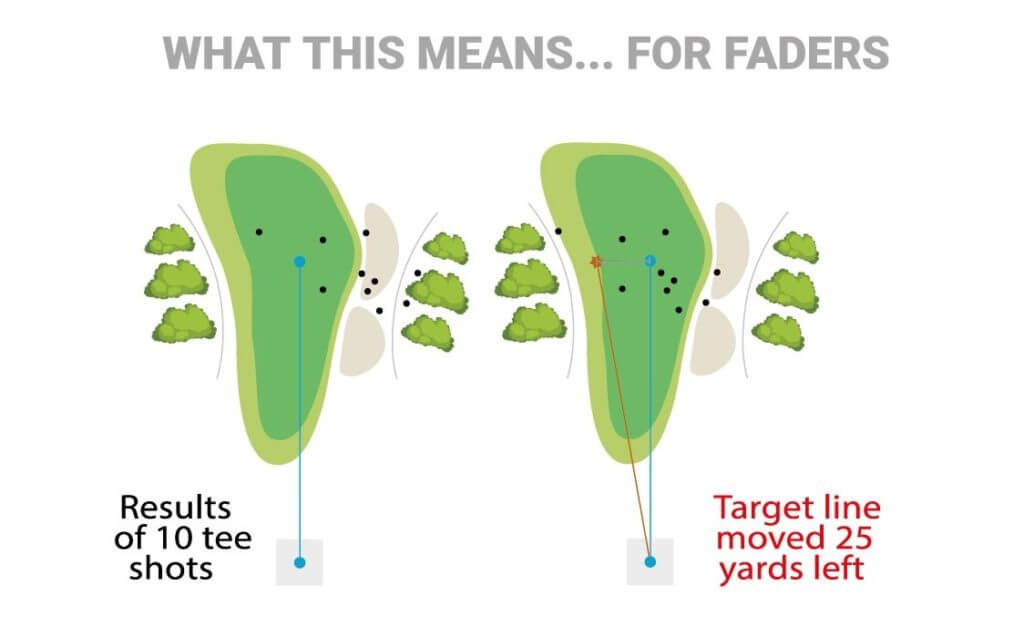
In fact, if the fader moved their target point 25 yards further left, into that playable light rough, their shot dispersion would result with only one ball in the fairway bunker and none in the trees. Furthermore, the number of shots now lost is now only 2.
As a result, by just by moving their target point, the fader can save 5 shots from 10 tee shots!
Now for Those Who Play a Draw
Golf course architects tend to be a little more forgiving to drawers of the golf ball. Indeed, as our example hole illustrates, there’s less bunkering down the left side of the fairway. However, that doesn’t mean drawers should go into autopilot and, accidentally, find themselves playing a recovery shot.
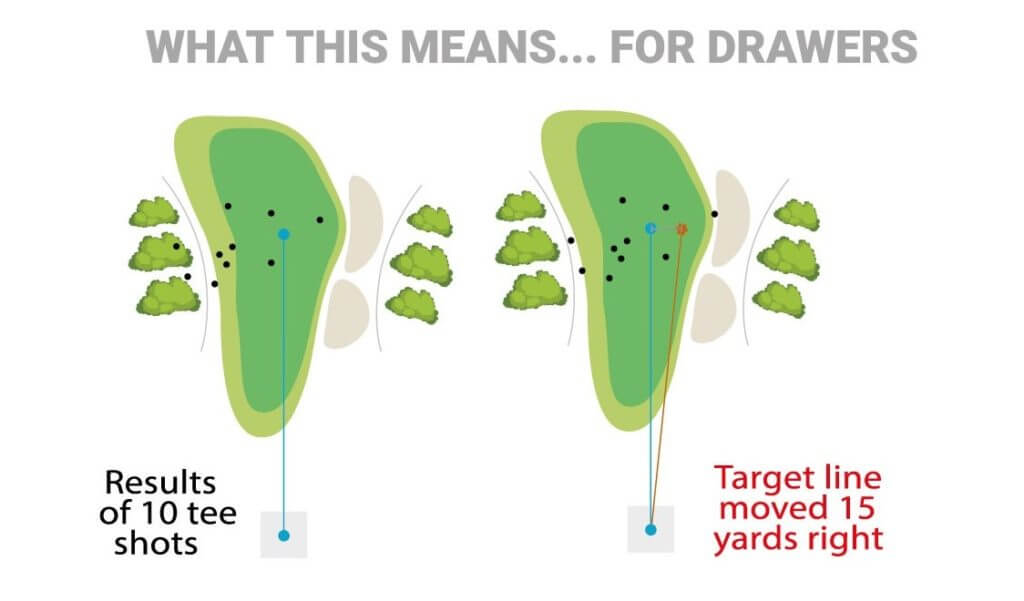
In fact, aiming straight down the middle of the fairway results in 3.4 shots lost left. But if the drawer adjusts their target line by merely 15 yards to the right, it frees up more space for the left miss and results in just 0.9 shots lost (and a gain of 2.5 shots).
The Two-Way Miss
I feel for this guy, especially since we all occasionally have our swing abandon us and can appreciate how frustrating it is when you’ve got no confidence while standing over the ball. But that doesn’t mean you need to start considering sacrificing one of your playing partners in the hopes of appeasing the golf gods and being welcome back into their good graces.
Instead, like I mentioned earlier, try to identify what kind of ball flight you’re getting that day (i.e., fade or draw biased) and adapt.

For this golfer, while their dispersion certainly wouldn’t exactly be described as “consistent,” by aiming down the middle they’re losing 4.8 shots. But my making a slight adjustment and moving their target line just 5 yards to the left, they can reduce the damage to 3.4 shots and gain back 1.4 shots.
While most regularly golfers are familiar with their miss, understanding how they can adapt (particularly with the help of a shot tracking system like Shot Scope) and alter their target line can be the difference between hunting birdies and pars from the fairway or light rough and, alternatively, licking your wounds, punching it out from the trees or a fairway bunker and hoping that you can minimize the damage.
Player data and graphics courtesy of Shot Scope


Ocean City Golf Trip Guide: Great Courses, Affordable Golf & A Beach Town Vibe

LIV Golf Could Be Facing its Final Chapter

Foresight GC2 Review: A Surprisingly Affordable Launch Monitor From Foresight

FIRST LOOK: Rapsodo MLM2XPRO Adds Putting, Faster Performance & More

FIRST LOOK: Titleist’s 2027 Pro V1 and Pro V1x Are Officially Showing Up on Tour
FIRST LOOK: Rapsodo MLM2XPRO Adds Putting, Faster Performance & More
Foresight GC2 Review: A Surprisingly Affordable Launch Monitor From Foresight
FIRST LOOK: Titleist’s 2027 Pro V1 and Pro V1x Are Officially Showing Up on Tour
LIV Golf Could Be Facing its Final Chapter
Ocean City Golf Trip Guide: Great Courses, Affordable Golf & A Beach Town Vibe

We Played This Old Golf Course Where Thomas Edison Was A Member

Are You MEASURING Your Golf Swing Correctly? (This Can Help)

Zach Johnson Explains Why He Didn’t Pick Bryson DeChambeau for the Ryder Cup

Justin Thomas FIRES Coach before Ryder Cup…Who’s Next?