
Golf Instruction
How to Hit a Great Golf Shot from a Downhill Lie


The slope of the ground under your feet is a big part of the challenge you face on any given golf shot. When the ground is level, you should have a much easier time staying balanced and striking the ball cleanly.
With that said, most golf courses aren’t flat!
You’ll get a flat lie on the tee, but after that, you never quite know what you will find.
In this article, we’d like to deal specifically with one type of uneven lie – the downhill lie. This is when the ground under your feet – and under the ball – is sloping down toward your target.
That might sound easier than playing from an uphill lie, but it can actually be quite difficult. There are a few key points to understand when learning how to play this shot, so let’s get started.
Understanding the Challenge
What is it that makes a downhill lie difficult? There are a couple of factors contributing to the challenge of this kind of shot.
First, there is the reality of needing to chase your swing down the hill to get to the ball.
As your clubhead moves through the downswing and towards the ball, the ground is moving away, and you have to stay down through the shot completely to hit it solid.
If you lift up at all before impact, you’ll hit the shot thin. At the same time, if you lean back into the hill a little bit, you’ll catch the turf before the ball, and the shot will come out very heavy.
So, that’s one challenge. The other issue you are facing here is the difficulty of keeping your balance.
It’s hard enough to stay balanced during a normal golf swing on flat ground. When you try to execute a swing on a downslope, it becomes that much tougher to stay centered while making an aggressive swing.
Between the difficulty of getting down to the ball at impact, and the challenge of keeping your balance, this is a hard shot. As with any tough shot in golf, you don’t want to run the other way and just throw up your hands. Rather, you need to create a plan for how to deal with this situation when it does arise.
Step #1 – Make a Soft Swing
You don’t want to be swinging as hard as you can when trying to play from a downslope. This is related to the topic of balance as mentioned above.
When you swing particularly hard, it’s difficult to keep your balance. By turning down the effort on your swing, you should have an easier time controlling your body weight from start to finish.
Of course, if you swing softer, you’ll need to use a little more club than normal to accommodate for that softer swing. Fortunately, shots from downhill lies are often shots that play downhill overall, meaning the target is lower than where your ball is resting. So, if it’s a downhill shot, and you are swinging softer, you might end up being able to use roughly the same club you would from flat ground on a flat shot.
With experience, you’ll learn how to gauge your distances in this situation so you can select the right club more often than not.
Step #2 – Match Your Shoulders to the Slope
With the understanding that you aren’t going to swing too hard, the next step to get ready for this shot is to alter your address position slightly.
As you take your stance, lower your left shoulder (for a right-handed golfer) to roughly match the angle of your shoulders to the slope of the ground. This is an extremely important adjustment that should help you swing down the hill and make good contact with the ball.
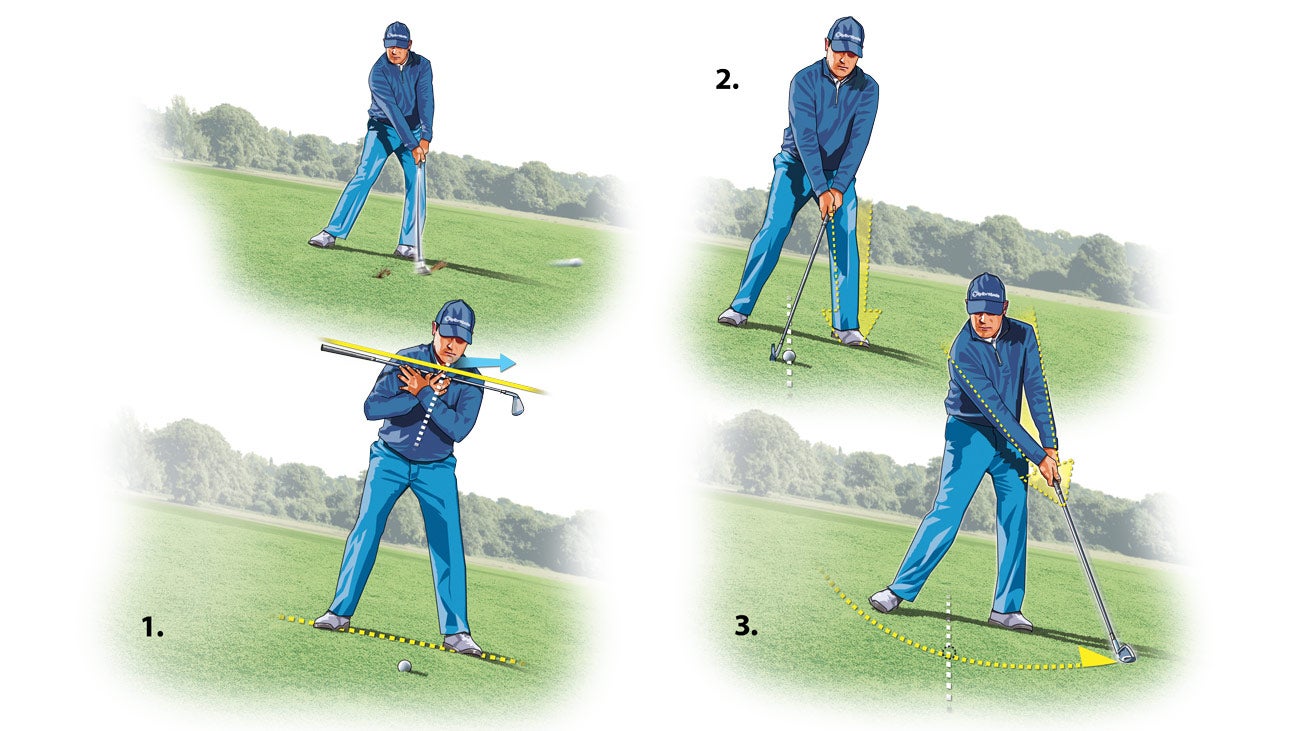
Image via Golf.com
While it’s beneficial to make this adjustment at address, you need to be aware that you can still go wrong once the swing begins. Specifically, you might fall into the trap of lifting up out of your stance shortly after you start the backswing. In other words, you may have set your shoulders to match the slope, but you can undo that setup if you lift up in the backswing and give away the angle.
Be sure to keep that left shoulder down as the swing goes back so you are in position to strike down through the ball when impact arrives.
Step #3 – Keep Your Head Down
Yes – this is the most commonly cited piece of golf advice, and you have almost certainly heard it a hundred times before. But it’s still important, and we still needed to list it here.
Keeping your head down through the shot is particularly critical when hitting from a downhill lie. If your head comes up as the club nears impact, even just a little bit, you’ll hit the shot thin.
To help keep your head down, pick out a specific spot on the ball and watch that spot with your eyes. Depending on how the ball happened to stop in the grass, you might be able to see the label on the top of the ball, or something that you’ve drawn on the ball prior to playing (like your initials).
Use any kind of spot you can pick out as something to focus on during the swing, and don’t let your eyes move from that spot until after the shot is on its way.
Downhill lies can be intimidating to be sure, but the three-step process we’ve outlined in this article will make them more manageable. With a softer swing, an altered address position, and a steady head, you can strike the ball cleanly and send it on its toward the target.
You’d like to strategically keep your ball away from these situations whenever possible, but that’s not always going to work out. With a good plan in mind, you won’t need to live in fear of the downhill lie any longer.


LIV Golf Could Be Facing its Final Chapter

Foresight GC2 Review: A Surprisingly Affordable Launch Monitor From Foresight

FIRST LOOK: Rapsodo MLM2XPRO Adds Putting, Faster Performance & More

FIRST LOOK: Titleist’s 2027 Pro V1 and Pro V1x Are Officially Showing Up on Tour

2026 Presidents Cup Preview: Did Team USA Get It Right?
2026 Presidents Cup Preview: Did Team USA Get It Right?
FIRST LOOK: Rapsodo MLM2XPRO Adds Putting, Faster Performance & More
Foresight GC2 Review: A Surprisingly Affordable Launch Monitor From Foresight

Turning Stone: The Northeast’s Most Underrated Golf Destination
FIRST LOOK: Titleist’s 2027 Pro V1 and Pro V1x Are Officially Showing Up on Tour

We Played This Old Golf Course Where Thomas Edison Was A Member

Are You MEASURING Your Golf Swing Correctly? (This Can Help)

Zach Johnson Explains Why He Didn’t Pick Bryson DeChambeau for the Ryder Cup

Justin Thomas FIRES Coach before Ryder Cup…Who’s Next?