
Golf Instruction
Pick ‘em Clean: How to Stop Duffing Your Chip Shots


The frustration that comes along with a duffed chip shot is hard to overstate.
As you get ready to hit the shot, you picture it coming off the club clean and bouncing right up next to the cup. Then, you make your swing, and… thud.
Every golfer knows that feeling, and it’s not a good one.
While we can’t promise to eliminate every duffed chip shot from your game, the advice in this article should help you reduce the frequency of these mistakes. So let’s get started!
What is a Duffed Chip Shot?
Before going any further, let’s make sure we are all on the same page regarding the meaning of the term “duffed” in this application. After all, there are plenty of ways to hit bad chip shots, but not all of them fall into the category of a duff.
For the purposes of this article, we are considering a duffed chip shot to be one where the club strikes the ground before the ball.
Basically, the club head bounces into the ball, and the shot usually comes up way short of the target. Golfers will commonly call this a “fat” shot, which is pretty much the same thing as a duff.
It’s important to understand the terminology here because correcting your technique after a duffed shot will require different adjustments than after a top, shank, etc.
Knowing what kinds of mistakes you are making is critical when trying to make the right changes.
Where the Duffed Chip Shot Goes Wrong
There are several mistakes that can lead to a duffed chip shot. As you are looking for the cause of this frustrating problem, look to one or more of the following errors.
Mistake #1: Scooping Through Impact
This is the leading cause of duffed chip shots, and it isn’t even close!
The average golfer has a hard time getting away from the thought that the ball needs help getting off the ground. So, as impact approaches, the hands and wrists jump into action, trying to scoop the club head under the ball to help it into the air.
Unfortunately, this is a huge mistake!
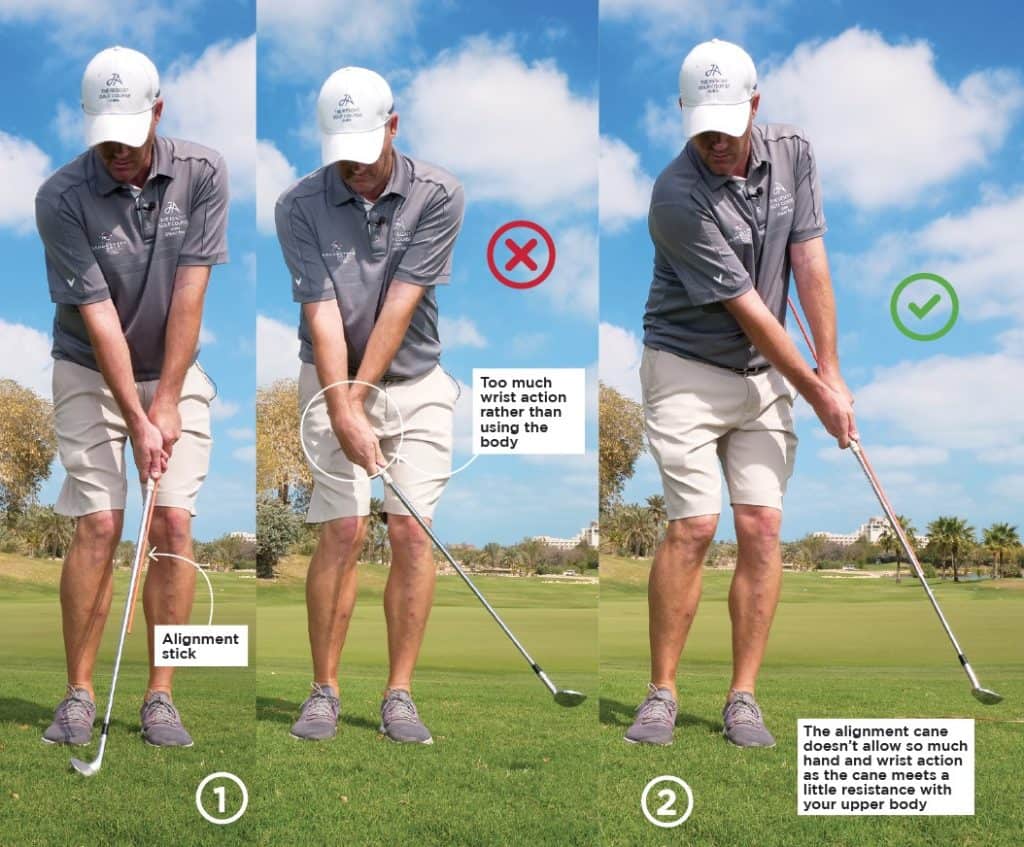
Image via Worldwide.golf
You don’t need to help the ball off the turf, and by trying, you are making it very likely that you’ll duff the shot. Keep your hands and wrists quiet and let the loft of the club do the work of getting the shot airborne.
Mistake #2: Slowing Down Before Impact
Another common problem that plagues golfers trying to hit solid chip shots is a loss of speed in the downswing.
As impact gets closer, you might get nervous about the outcome of the shot – and you may slow the club down as a result, just to be safe.
Of course, this isn’t being safe at all, as slowing the club down is sure to lead to a poor outcome.
To be consistent with your chip shots, it’s necessary to trust your technique and keep the speed of the swing up through impact and into the finish.
Mistake #3: Poor Address Position
This is less common, but duffed chip shots will sometimes be caused by an incorrect stance. Specifically, if you have the ball way too far back in your stance, you’ll be making a steep downswing, and that steep downswing might occasionally cause a duffed chip.
It’s a good idea to swing down into your chip shots, but you don’t want such a steep downswing that you wind up sticking the club right into the turf.
Looking at the list above, it’s not only easy to see how duffed chip happens, but it’s also easy to see what you need to avoid in order to hit good chip shots. In other words, if you can avoid scooping, keep the speed of your swing up, and build a quality stance, you’ll be in great shape.
How to Get Your Chips Shots on the Right Track
If you have been stuck in a pattern of duffing your chip shots, it’s about time to break that streak and start striking them cleanly again (or for the first time).
It can be hard to break out of a negative pattern in the short game, so there is going to be some hard work required to alter both your technique and your attitude toward chipping.
The first step toward moving away from duffed chips is to start practicing with lower lofted clubs. It’s much easier to hit a clean chip with an 8-iron than a lob wedge, so give yourself a break while you work on improving your results.
While practicing these 8-iron chip shots, pay attention to your lead wrist through impact. If it stays flat and firm, that’s a great sign that you aren’t scooping.
As your results start to improve and the contact you make gets more and more reliable, go ahead and work back up into the higher lofts for a bigger challenge.
One Other Important Fundamental
We already talked about how things can go wrong when chipping regarding too much hand action or deceleration through impact. There is one other crucial point we need to touch on before wrapping this up, however – and that is your head position during the shot.
Your head needs to stay very still during the swing while you are chipping, as too much movement will make it very difficult to achieve clean contact.
It’s okay for your head to move a bit in the full swing since that is such an aggressive action. Chipping is not as aggressive, so you don’t need to let your head move around.
Keep your head as still as you can, just like when you are putting, and you’ll find that the quality of your contact improves quickly.
Don’t let chipping frustrations discourage you from going out on the course for rounds of golf with your friends. Yes, chipping is one of the most challenging parts of the game, but that doesn’t mean you can’t make progress and gradually improve your skills.
Stay patient and keep cleaning up your technique until duffed chip shots are mostly a thing of the past.


LIV Golf Could Be Facing its Final Chapter

Foresight GC2 Review: A Surprisingly Affordable Launch Monitor From Foresight

FIRST LOOK: Rapsodo MLM2XPRO Adds Putting, Faster Performance & More

FIRST LOOK: Titleist’s 2027 Pro V1 and Pro V1x Are Officially Showing Up on Tour

2026 Presidents Cup Preview: Did Team USA Get It Right?
2026 Presidents Cup Preview: Did Team USA Get It Right?
FIRST LOOK: Rapsodo MLM2XPRO Adds Putting, Faster Performance & More
Foresight GC2 Review: A Surprisingly Affordable Launch Monitor From Foresight
FIRST LOOK: Titleist’s 2027 Pro V1 and Pro V1x Are Officially Showing Up on Tour
LIV Golf Could Be Facing its Final Chapter

We Played This Old Golf Course Where Thomas Edison Was A Member

Are You MEASURING Your Golf Swing Correctly? (This Can Help)

Zach Johnson Explains Why He Didn’t Pick Bryson DeChambeau for the Ryder Cup

Justin Thomas FIRES Coach before Ryder Cup…Who’s Next?
