
Courses
Prestwick, Home of The Open

At Prestwick Golf Club in Ayrshire, Scotland, the first thing the caddie asked was, “What’s your handicap?” When told, Colin pulled out the four iron and replied, “Okay. Now I want you to play a 190 possession shot right between the two ‘boonkers’ there”.
As I looked down the first hole (called Railway, because of the train line running down the entire right side) I saw that if I didn’t hit the 190 yard shot and land it between the ‘boonkers’ I’d basically be dead: Railroad tracks and O.B. on the right, a high sand dune and lots of gorse to the left (just forget that, you’ll never find it in the gorse). And as if that wasn’t enough, hillocks and tufts of rough short and apparently all around the humpy little green with its flag waving merrily next to the brick wall of the Railway.
That small patch of fairway looked like the bulls-eye on a dart board. But, you have no alternative. You have to hit it. This is target golf. That’s what we call it now, as one of the more recent innovations in golf course design. Only, it occurs to you as you see it hole after hole at Prestwick, it’s not so recent. It was a part of the game 170 years ago.
As I sat by a warm coal fire after the round, sipping pint after pint of Guinness, I thought long and hard about this. Why all the patches of grass? Why not fairways? The Prestwick layout was created in 1851 by Old Tom Morris who came over from St. Andrews on contract to make the 12 hole course. Six of the original greens are still in use today.
Imagining Old Tom out there with his crew led to the thought that it would be pretty extravagant and fairly stupid in the eyes of the membership to spend money on making a fairway when all one needed was a patch of grass driving distance from the tee.
The 57 original members who hired Old Tom were, no doubt, thrifty Scots. “The Hay with the Fairway, Old Tom, let’s be practical, man.” That’s what they must have thought, anyway. Ah, the clarity that Guinness provides…
Tom was still the Keeper of the Green in 1860 and renowned as a player. But he wasn’t the best player in Scotland. By general acclaim, the title of Champion Golfer would have gone to Alan Robertson of St. Andrews. Robertson, like Morris, was one of the first to make a living from making golf clubs, golf balls, caddying and playing for money. In fact, the St. Andrews locals liked to say that he never lost when playing for money.
When Robertson died in 1859, the Prestwick boys decided to hold a tournament in his honor in order to see who would be the next Champion Golfer. Of course they expected that their Old Tom would assume the mantle.
So in October of 1860 the first Open Championship was held at Prestwick. Eight professionals competed for a very expensive Championship Belt: red Moroccan leather with heavy silver ornamentation. Old Tom finished second by two shots to one Willie Park of Musselburgh.
It was the following year, 1861, that Old Tom Morris won the first of his four Open Championships. His son, Tom Morris, also won four Open Championships. After 12 such tournaments, the boys at the R&A of St. Andrews and The Honorable Company of Edinburgh Golfers (Muirfield) got in on the action and the tournament began a rotation between courses. Prestwick held the last of its 24 Open Championships in 1925.
These days they say, it’s too small, too short (6544), not enough hotel space, no parking, not enough room for spectators and viewing stands, no space for corporate tents, etc., etc. I’m not sure I buy all that. Rather, I think it has something to do with the fact that it just doesn’t look like what people imagine a golf course to look like. It would be strange. A public relations and image problem. Too bad…
I parred that first hole by following Colin’s instructions. It was a little like playing hop scotch, when after throwing the charm into the appropriate box, one hopped from box to box until completing the course. But when I couldn’t stay within the boxes, the course began extracting a toll.
Any error in the flight of the ball is magnified by the wind and costs you. If the wind doesn’t get you then the unexpected bounces do. And if the bounces don’t get you then the pot bunkers and slick lumpy greens do. You’re just going to get it, that’s what you quickly understand, and you resign yourself to it.
Golf must originally have been more of a match play game. It had to be. The unexpected is the norm on this course. And luck and fortune constitute a large part of the play. In the ‘fairway’ the ball bounces around like it’s hitting the rocks of a dry creek bed, and a good shot is one that doesn’t end up in rabbit hole. Medal scoring is for self-flagellators only.
Each hole was unique. And each had a surprise, often a nasty one. The Seventeenth (Alps) was so astonishing, dramatic and beautiful that no amount of Guinness could get it out of my mind. To describe it as a 391-yard dogleg right par four doesn’t begin to do it justice.
From the tee, you can see the first 340 yards. There’s a thin landing patch out there that bends to the right and goes around a thick gorse forrest, then climbs half way up a high dune. The wind blows across the hole from your right to left requiring you to aim your tee shot at the gorse!
That shot is daunting, but the next is even more so. On top of the dune there are three tombstone-like wooden markers that are aiming points. The green is somewhere over yonder. You have no idea what to hit or what to expect.
When you get to the top of the dune and look over, what you see just makes you gasp: one of the biggest sand traps in the world. The far side of the dune is pitched downward at 45 degrees and covered with wild rough. At the foot of the dune is this cavernous bunker about 35 yards wide by 20 yards across and deep enough to require staircases for exiting. And it butts up against a triple tiered green that is further surrounded on its backside by thickly covered 5-foot high shoulders of heavy rough.
In other words, if you don’t hit the green with this blind second shot, you have trouble, my friend. Trouble with a capital T, and that rhymes with P, and that stands for Prestwick. What a hole! What a challenge. What fun. Old Tom must have had a few laughs over his Ps and Qs about that one.
One other ‘nasty’ deserves mention: the fescue. This stuff looks so innocent, so benign, like no problem for a healthy male. Just blast it outta there! Ha! The wispy foot long blades wrap around the hosel and shaft and flip the club face left. ‘I know I can do this!’ I kept telling myself. Four whacks in a row only advanced the ball a hundred yards and still didn’t get out of the stuff. Trouble… right here in River City.
The whole day at Prestwick was a flat out, no holds barred, frontal assault of Scottish golf: wind, rain, cold, mist, dunes, sunshine, double bogeys, gorse, pot bunkers, rough, and a caddie who’d say with such simplicity, “Just play it a wee bit to the right of the rain shed and let the wind carry it back in.” After a few holes, I quit trying to be a hero and just listened. It was a lot better than thinking, “Over the rain shed?! Are you kidding? I only have one ball left! What if I lose this one? I paid a fortune to get here and play this course and now I may not be able to finish!!!”
Prestwick Golf Club, ‘Home of the Open’ as it styles itself is the greatest natural golf course I’ve ever seen. My guess is that not many American visitors like this course because it’s so unlike anything you’d see Stateside, but treat yourself if you can and share a laugh with Old Tom Morris. Go see where and how it all began.
After the round you can go across the street to the North Beach Hotel bar, sit by the fire and drain a couple of pints of Guinness. Ah, what a treat that is. Sit in the front room and look out at the course with its wild, untamed and captivating natural beauty.
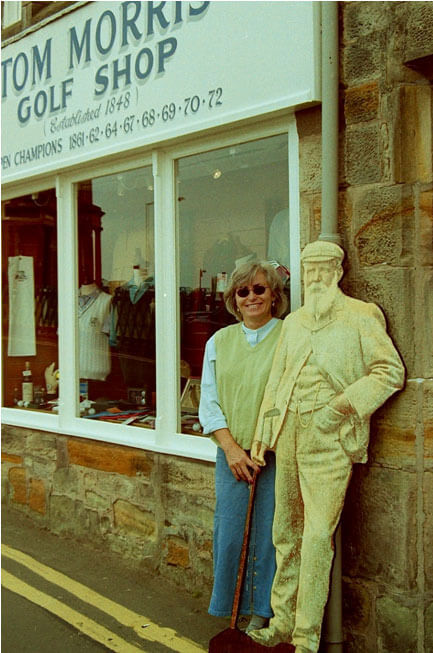
My wife and Old Tom
They close the course at 8 P.M. But in the summer there are still four hours of daylight left. With that Guinness working its magic, I felt like having another go at the 17th. So, at 9:40 P.M., I grabbed the sticks, ambled over and had at it again. That hole struck such resonant chords in me, it was practically a religious experience. I almost bayed at the rising moon.
Cover Photo via Instagram


LIV Golf Could Be Facing its Final Chapter

Foresight GC2 Review: A Surprisingly Affordable Launch Monitor From Foresight

FIRST LOOK: Rapsodo MLM2XPRO Adds Putting, Faster Performance & More

FIRST LOOK: Titleist’s 2027 Pro V1 and Pro V1x Are Officially Showing Up on Tour

2026 Presidents Cup Preview: Did Team USA Get It Right?
2026 Presidents Cup Preview: Did Team USA Get It Right?
FIRST LOOK: Rapsodo MLM2XPRO Adds Putting, Faster Performance & More
Foresight GC2 Review: A Surprisingly Affordable Launch Monitor From Foresight
FIRST LOOK: Titleist’s 2027 Pro V1 and Pro V1x Are Officially Showing Up on Tour
LIV Golf Could Be Facing its Final Chapter

We Played This Old Golf Course Where Thomas Edison Was A Member

Are You MEASURING Your Golf Swing Correctly? (This Can Help)

Zach Johnson Explains Why He Didn’t Pick Bryson DeChambeau for the Ryder Cup

Justin Thomas FIRES Coach before Ryder Cup…Who’s Next?
