
Courses
Teeth of the Dog at Casa de Campo

It’s the middle of the night. I’m tossing and turning. Thinking about all manner of dumb things. Things that have to be done. Bills that have to be paid. Relationships that should be cultivated. Blah. Blah. Blah. On and on it goes. No relief. No sleep. Turn over again.
Until, I start to think about the golf course. The one that gets me more than any other. The perfect cut and green hue of the grass. The blue of the cloudless sky. The white of the crashing surf. The little yellow flags snapping in the sea breeze. The angst and tension ebb into the background of my imaginary round.
I’m at Casa de Campo in the Dominican Republic. I’m playing Teeth of the Dog. The course that makes harmonious and beautiful music with my golfing soul. I’ve played all over the world, and this is the one course I always come back to.
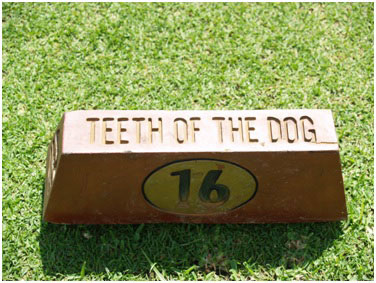
What is it that calls me back over and over again? What is it that haunts the memory and beckons like a lover?
The physical beauty of the place is certainly factor number one. Set on the southern shore of the island of Hispaniola, Teeth has incredibly beautiful flora, perfectly maintained grasses, tees, fairways and bunkers, and 7 holes right along the water: four holes out with the water on the left, and three back in with the water on the right.
Some par three greens are down low near the rocks and surf, and set out there on little promontories so that your tee shot has to carry or die. The par fours on the water are cliff high and directly above the crashing breakers.
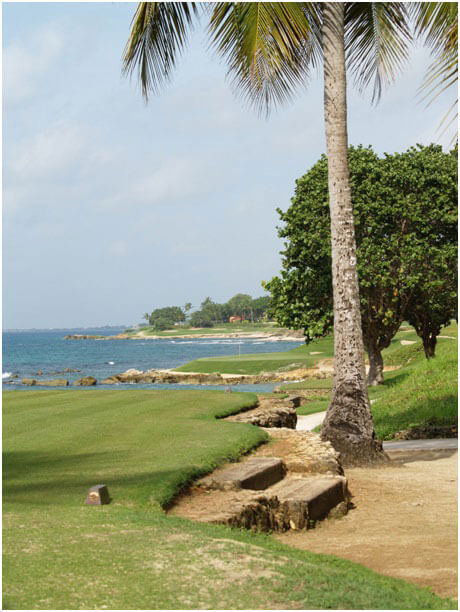
5th hole and 7th in the distance.
The first time I putted on the 16th green, the hole named Teeth of the Dog, I was standing about 3 feet from the edge of the cliff and trying to putt toward a center flag. I swear I could feel the earth beneath me tremble a bit as if it were about to slide 40 feet straight down into the sea. I may have rushed that one.
The inland holes ask no quarter. They are awesome: strikingly individual, each with its own unusual challenge, maybe a waste area or football field size trap, and each hole asking for your best shot on every shot. And each green demanding the best of your short game.
But more than the physical beauty of the place, it’s the Pete Dye design that puts a perfect icing on an already beautiful cake. The course, which opened in 1971, was one of his early works. Think of it as the first masterpiece of a great artist. The Casa de Campo folks were so elated with the outcome that they gave the Dyes a big ocean front lot behind the 17th green where they built a fabulous home.
Hole by hole, you can see the golfer as designer giving free reign to every creative impulse. No hole is simple. And none are simply straightforward — there you see it, flat green flanked by two traps and on to the next. Each hole has a plan. Each has a route. Each has a personality. You work backwards from the green to appreciate the plans: ‘easiest approach would be from there, and to get there, you need to hit from here. So you need to play this kind of tee shot.’
Even though there’s plenty of room out there, the correct tee shot sets up the hole. And when you get to the preferred landing spot and see it open up, you can almost feel the joy of the artist at work. Every hole is unique and uniquely beautiful. Every shot has been carefully thought out in terms of risk and reward. Every hole brings unexpected delights, unexpected vistas and oh-so-tempting dangers.
It’s not just that Dye has an artistic eye and creates unusual visual images and challenges, it’s also the fact that his holes demand shots. Leftish off the tee, rightish on the second and high and stopping quickly on the third is a possible 5 par combo. Right side open, left side closed, or vise versa on the 4 pars. Greens on diagonals so you have to be on the high side of the fairway in order to open up the incoming shot.
And getting to the high side is not always easy. But he always gives you the option to bail and play it the other way. Of course, you pay for that. In strokes. And anguish. And maybe in remorse. But not much.
All of the greens are tough to hit and tough to putt: slick and smallish with multiple levels and subtle breaks. Many are defended by small grassy hillocks and depressions where you have to pitch, chip and lob your best. There are also deep grass bunkers. And sand bunkers, too. Lots of them and all different sizes and shapes. But the bunkers not the principal defender on most holes, the greens complexes are.
There are also huge waste areas and bunkers hundreds of yards long. These big hazards are so visually striking that they start to play havoc with your sensibilities. Like… ‘stay away from that thing!’ That’s usually a good indication that if you hug the hazard you’ll have the best line into the green.
Dye began to design Teeth in 1969, hot off of his acclaimed Harbour Town Golf Links on Hilton Head Island. Harbour Town hosts the annual Heritage Classic on the PGA tour and is the pros’ favorite tour course. That says a lot about the designer.
Teeth was built on old coral wasteland. Like the Links courses in Scotland that grew out of land unfit for sheep or cultivation, so too did the Teeth. Couldn’t grow sugar on that coral waste, so Dye came in and worked for two years moving dirt, shaping, planting, growing and created a thing of rare beauty. He brought out the best of the landscape and combined it with demanding shotmaking. The result is a top of any list course.
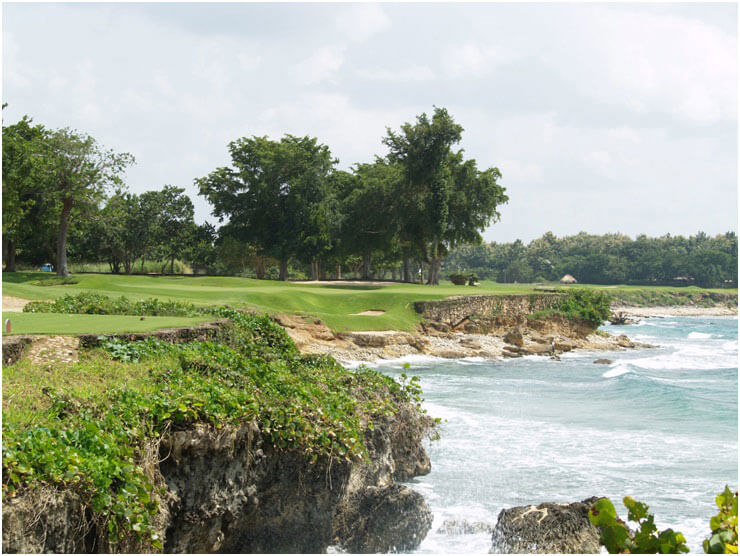
The name for the course came to him one night as he was thinking about the 16th hole. A 220 yard par three over the water where much of the sea wall is made of jagged coral outcroppings that looked to the locals like the teeth of a dog. Not a bad name for the course, he thought, and that was it.
I admit it, I’m a Pete Dye fan. I’ve played a dozen of his better courses, and they all leave haunting memories. The kind of vibes that just demand another visit and more golf. Consider The Ocean Course at Kiawah, Whistling Straights at Kohler, TPC at Sawgrass, PGA West at La Quinta,. They’re all Championship courses. They’re all sons and cousins of Teeth. Once you play them, you’ll be planning a return trip to play them again.


Foresight GC2 Review: A Surprisingly Affordable Launch Monitor From Foresight

FIRST LOOK: Rapsodo MLM2XPRO Adds Putting, Faster Performance & More

FIRST LOOK: Titleist’s 2027 Pro V1 and Pro V1x Are Officially Showing Up on Tour

2026 Presidents Cup Preview: Did Team USA Get It Right?

Turning Stone: The Northeast’s Most Underrated Golf Destination
2026 Presidents Cup Preview: Did Team USA Get It Right?
FIRST LOOK: Rapsodo MLM2XPRO Adds Putting, Faster Performance & More
Turning Stone: The Northeast’s Most Underrated Golf Destination
Foresight GC2 Review: A Surprisingly Affordable Launch Monitor From Foresight
FIRST LOOK: Titleist’s 2027 Pro V1 and Pro V1x Are Officially Showing Up on Tour

We Played This Old Golf Course Where Thomas Edison Was A Member

Are You MEASURING Your Golf Swing Correctly? (This Can Help)

Zach Johnson Explains Why He Didn’t Pick Bryson DeChambeau for the Ryder Cup

Justin Thomas FIRES Coach before Ryder Cup…Who’s Next?