
Golf Instruction
Swinging Too Hard? Here’s How to Have a More Controlled Golf Swing

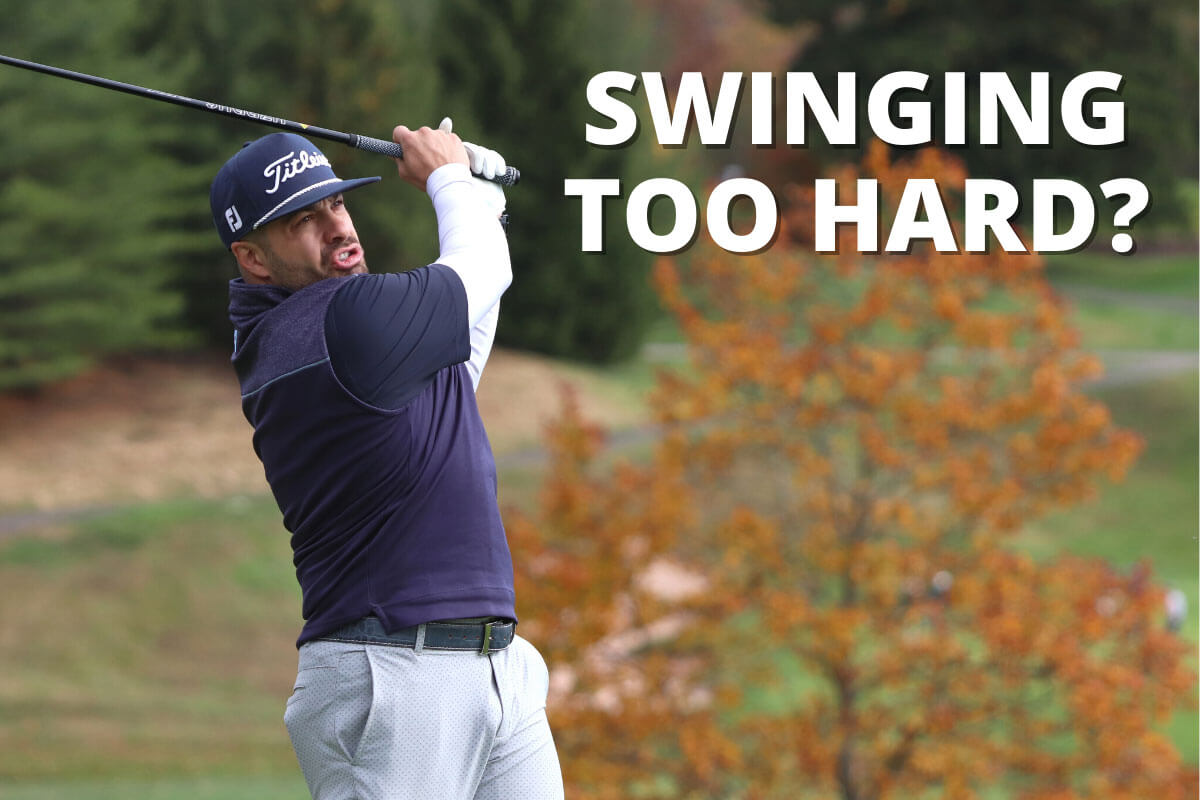
Look, we get it – hitting the ball hard is fun.
Everyone loves seeing their tee shots soar off into the distance, hanging in the air for what feels like minutes before dropping into the middle of the fairway.
It’s a beautiful thing.
Unfortunately, in an effort to make that vision a reality, many golfers swing far too hard.
Putting too much effort into the swing is usually going to lead to diminishing returns, where the quality of your ball striking – and even your raw distance – actually goes down as you swing harder.
Remember, the club only needs to be moving fast at the moment it strikes the ball. Everything else is just a build-up to that point.
So, with this issue in mind, we’d like to use this article to help you get your swing under control. With any luck, the advice below will help you tone down your wild swings, and you just might start to hit the ball better than ever before.
The Difference Between a Hard Swing and a Powerful Swing
If you are currently swinging too hard, you are probably doing it because you want to hit the ball as far as possible. And, in your mind, that hard swing is going to be strongly correlated with longer shots.

As you look into what really matters in the golf swing, however, you’ll find that swinging hard really doesn’t lead to the outcomes that you desire.
While you are making a hard swing, what you really want is a powerful swing.
A powerful swing is one where the speed of the club head is maximized right at the moment of impact. This is the kind of swing you will see from any professional golfer. Everything before impact is just laying the groundwork for an aggressive, powerful strike.
When you think about what a professional golf swing looks like, you probably wouldn’t say it looks like the player is swinging “hard” (with a few exceptions). Most pros look like they are making smooth, easy swings – and the result is still an incredibly powerful shot that soars into the distance.
Producing Power Like the Pros
So, how do they do it? Well, it takes more than can be explained in one article, but let’s look at some of the basics for turning your swing from a hard one into a powerful one.
#1 Balance is the Key Component of Power
Believe it or not, the balance that you maintain in your golf swing is one of the biggest pieces of the power puzzle. If you aren’t balanced during your swing – especially at the top of the backswing – you will struggle to produce any real speed.
Since you’ll be fighting your balance just to stay on your feet during the downswing, you won’t be able to rotate toward the target with the kind of speed that generates good power at impact.
If you ever find yourself at the driving range trying to figure out what to work on, always revert back to the fundamental of balance.
#2 Make Room for Acceleration
Swinging hard usually just means rushing the swing from start to finish, putting in a lot of effort without getting much in the way of results. To gain control over your swing while still having the capacity for serious power, work on making a big shoulder turn away from the target.
With a big turn – and the balance we talked about above – the stage will be set for you to finally unleash your power on the way down.
#3 Use Your Lower Body
The lower body is the engine of the golf swing. From the flex in your knees to the way your hips rotate in the downswing, much of the power you can create comes from the waist down.
So, don’t miss out on the opportunity to build speed by using your lower body effectively.
Specifically, make sure your hips are in charge of starting the downswing by turning them aggressively toward the target as soon as you get to the top. Letting your hips lead the one is one of the biggest “secrets” in the search for added distance.
If you are able to work on each of the three points above – balance, a big shoulder turn, and using your lower body effectively – you will be well on your way toward great ball striking. And, once you improve in these areas, you’ll find that you no longer feel the need to swing so hard.
Making the Right Decisions
Some golfers swing too hard because they don’t understand the basic mechanical elements of the swing that we explained in the previous section. Others, however, manage to execute those mechanics pretty well – only to have it all fall apart when they get out onto the course.
If you find that you slip into the bad habit of swinging too hard once you get to the first tee, your problem is probably more mental than it is physical.
For many players, swinging too hard – or overswinging – on the course comes down to poor decisions. Some examples are below:
#1 Not Using Enough Club
Picking a club that will only reach the target if you absolutely flush it is likely to cause an overswing. Instead, use a club that can reach your target distance with a smooth, comfortable swing.
#2 Trying to do too Much
Sure, it would be fun to fly your second shot 280-yards onto the green of a par five, but do you really have that shot in the bag? If you force yourself to do something outside of your capabilities, you’ll wind up swinging too hard and probably hitting a bad shot.
#3 Keeping up with the Group
All golfers have been guilty of this at one point or another. Instead of just playing your own game, you try to reach back and hit it as hard as possible to outdrive your buddies. This is another way to lose your rhythm during a round.
As you gain experience in this game, you’ll probably find that you are less and less inclined to overswing. Simply put, there isn’t much good that is going to happen when you swing extra hard.
Do your best to leave this habit in the past by focusing on your fundamentals and striving to control your swing – and the ball – to the best of your ability.


LIV Golf Could Be Facing its Final Chapter

Foresight GC2 Review: A Surprisingly Affordable Launch Monitor From Foresight

FIRST LOOK: Rapsodo MLM2XPRO Adds Putting, Faster Performance & More

FIRST LOOK: Titleist’s 2027 Pro V1 and Pro V1x Are Officially Showing Up on Tour

2026 Presidents Cup Preview: Did Team USA Get It Right?
2026 Presidents Cup Preview: Did Team USA Get It Right?
FIRST LOOK: Rapsodo MLM2XPRO Adds Putting, Faster Performance & More
Foresight GC2 Review: A Surprisingly Affordable Launch Monitor From Foresight
FIRST LOOK: Titleist’s 2027 Pro V1 and Pro V1x Are Officially Showing Up on Tour
LIV Golf Could Be Facing its Final Chapter

We Played This Old Golf Course Where Thomas Edison Was A Member

Are You MEASURING Your Golf Swing Correctly? (This Can Help)
Zach Johnson Explains Why He Didn’t Pick Bryson DeChambeau for the Ryder Cup

Justin Thomas FIRES Coach before Ryder Cup…Who’s Next?
