
Golf Instruction
The Key to Keeping Your Lead Arm Straight in the Golf Swing


Maintaining a straight lead arm in the golf swing is a core fundamental that will help you achieve consistent, reliable ball striking.
Sure, you can play with a soft, or bent, lead arm and still hit good shots, but most players find that approach more challenging.
Keeping that lead arm straight – the left arm for a right-handed player – should likely be your goal.
So, how do you make it happen? It’s actually pretty simple, but there are a couple of places where you can get tripped up.
Let’s take a look at the basics of this concept and how you can practice making a repeatable swing with a straight lead arm.
Find the Right Address Position
To get started on mastering this part of your swing, the first key is to put your body in the right position at address. Of course, that can be said for many different parts of the swing – a good address position is always critical for your success in this game.
Starting with your lead arm straight is going to make it dramatically easier to keep it straight once the swing gets going.
If that lead arm is bent at address, you’ll struggle to straighten it out at any point during the swing, even if the rest of your technique is spot on. Make sure your lead arm is straight when you take your stance and allow your trailing arm to be slightly bent as you work it into a comfortable position.
Getting from Address to Impact
It’s pretty easy to create an address position that features a straight lead arm, and you might already be doing so without ever having thought much about it. Once the swing goes in motion, however, things quickly become more difficult.
So, how do you get from address back to impact without losing your straight lead arm along the way? Consider these tips:
1. Quiet hands in the Takeaway
Using the hands too actively in the takeaway phase of the swing is a common error among average golfers. This mistake can lead to several problems, including the eventual breakdown of the lead arm.
If you use your wrists to get the club moving in the takeaway, you’ll start a “folding” action that may move up to your lead elbow before you even get to the top of the swing.
Avoid this fate by using your big muscles to start the swing.
Rather than the muscles in your hands and wrists doing the work, turn your shoulders away slowly to put the club in motion. This is a smooth, repeatable action that will do you swing a world of good.
2. Make a Strong Shoulder Turn
The biggest reason for golfers to lose their straight lead arm during the backswing is a poor shoulder turn.
When the shoulders stop turning, the club needs to find a way to keep moving until it reaches the top of the swing. Often, the way the club keeps moving is by breaking down the lead arm, so it bends at the elbow. This gives the club the ability to get to the top, or near the top, but it comes at a significant cost.
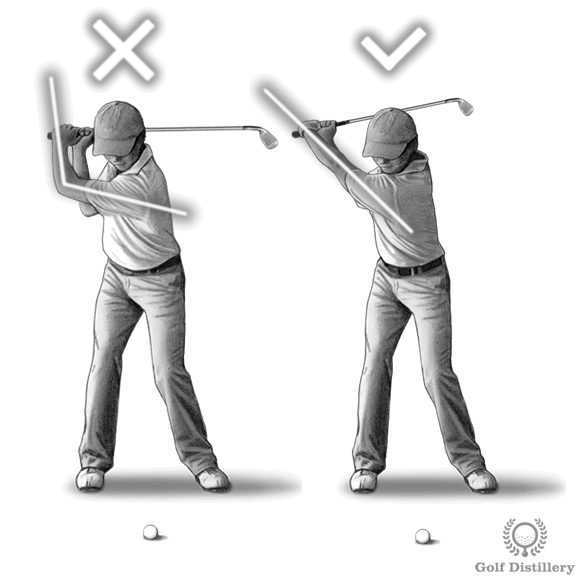
Photo via GolfDistillery.com
All of this can be avoided if you do a good job of turning your shoulders throughout the backswing. Rotate fully away from the target while keeping the club in front of your chest until the backswing is complete.
This way, your lead arm is likely to stay straight, and you will be in a powerful position to start your downswing with confidence.
3. Lower Body Drives the Downswing
If you manage to make it to the top of your backswing with a straight lead arm in place, most of the job has been done. However, things can still go wrong, so it’s important to stay on top of your technique all the way through impact.
For the downswing, that means letting your lower body lead the way as you turn toward the target.
If the lower body gets stuck in neutral and doesn’t go anywhere, your arms will swing down by themselves, and the lead arm might end up bending as a result.
The good news hidden in these three points is that working on them won’t only benefit the performance of your lead arm – each of these points is crucial to the quality of your swing as a whole.
Any player who consistently checks off these three points in the golf swing will be in a great position to strike some quality shots.
The Difference Between a Straight and Locked Lead Arm
For the vast majority of golfers, keeping the lead arm straight is going to mean good things. With that said, it’s important to understand that “straight” doesn’t mean “locked,” and you should pay attention to how your arm feels at address and during the swing.
If you are trying so hard to keep the arm straight that you are adding tension to your body, the net impact could be negative rather than positive.
Tension means bad things in golf. Whether it is during a full swing or while making a putting stroke, tension will only get in your way and wreak havoc. This is why so many players do something like take a deep breath or shake out their hands before hitting a shot – they are trying to get rid of tension.
While working on keeping your lead arm straight, keep this in mind and be careful not to tighten up the muscles in that arm so much that you feel tense and restricted.
Yes, you want to keep the arm straight, but do so in a relaxed and comfortable manner.
If you have been playing with a bent lead arm and your ball striking is not at the level you would like to see, consider working on changing that arm position in the swing. By straightening it out, you should add width to your swing, which is great for both power and ball striking consistency.
Good luck working on this important fundamental!


LIV Golf Could Be Facing its Final Chapter

Foresight GC2 Review: A Surprisingly Affordable Launch Monitor From Foresight

FIRST LOOK: Rapsodo MLM2XPRO Adds Putting, Faster Performance & More

FIRST LOOK: Titleist’s 2027 Pro V1 and Pro V1x Are Officially Showing Up on Tour

2026 Presidents Cup Preview: Did Team USA Get It Right?
2026 Presidents Cup Preview: Did Team USA Get It Right?
FIRST LOOK: Rapsodo MLM2XPRO Adds Putting, Faster Performance & More

Turning Stone: The Northeast’s Most Underrated Golf Destination
Foresight GC2 Review: A Surprisingly Affordable Launch Monitor From Foresight
FIRST LOOK: Titleist’s 2027 Pro V1 and Pro V1x Are Officially Showing Up on Tour

We Played This Old Golf Course Where Thomas Edison Was A Member

Are You MEASURING Your Golf Swing Correctly? (This Can Help)

Zach Johnson Explains Why He Didn’t Pick Bryson DeChambeau for the Ryder Cup

Justin Thomas FIRES Coach before Ryder Cup…Who’s Next?

What Nobody Tells You About Great Ball Striking
-
 Equipment1 week ago
FIRST LOOK: Rapsodo MLM2XPRO Adds Putting, Faster Performance & More
-
 Equipment7 days ago
Foresight GC2 Review: A Surprisingly Affordable Launch Monitor From Foresight
-
 Equipment1 week ago
FIRST LOOK: Titleist’s 2027 Pro V1 and Pro V1x Are Officially Showing Up on Tour
-
Podcasts16 hours ago
LIV Golf Could Be Facing its Final Chapter