
News
The USGA and the R&A Plan to “Save” Golf by Making it Harder

Golf is hard. You know this, I know this, we all know (and experience) this. Unfortunately, however, the decision makers at the USGA and The R&A seem oblivious to this and believe that golf needs to be “saved” by making the game harder.
View this post on Instagram
In an era where everyone in the industry is adamant about “growing the game”, you would think the last thing we would do is take an already difficult task and make it even more frustrating than it was.
Nevertheless, the USGA and The R&A published the 2020 Distance Insights Report earlier this week and determined that golf, apparently, has a distance problem, despite acknowledging that the average amateur male golfer is only driving the ball somewhere between 210 and 220 yards.
View this post on Instagram
Yes, I get it that guys like Cameron Champ, Rory McIlroy, Dustin Johnson and Brooks Koepka are all averaging more than 300 yards off the tee. But I think the powers that be have failed to realize that we’re talking about a problem that affects only a small portion of the approximately 250 touring pros. Indeed, only 51 golfers (according to the 2019 PGA Tour stats) averaged over 300 yards off the tee.
That’s not most, not half, not even a third.
And I read (most) of the report, and I recognize that an overwhelming majority golf fans do not want to watch events held at courses play at more than 8,000 yards of length and, instead, strongly prefer that golf be played at “heritage” courses like Augusta National or St. Andrews.
However, I genuinely don’t think the USGA and The R&A bothered to investigate whether decreasing distance is actually, according to USGA CEO Mike Davis, in the “best interest of all golfers.”
“I go to Bandon, play the courses from the back tees, which are
less than 7,000 yards. I break my personal scoring records every time. It’s too easy. I hope they roll the ball back for ams.”~NO ONE!— Matt Ginella (@MattGinella) February 4, 2020
To help illustrate the brief investigation that bolsters my (and Matt Ginella’s) point (and concerns), I think it’s important that we first are all in agreements that “golfers” refers to people who play golf, and NOT people who watch golf on TV (who would more appropriately be identified as fans and/or spectators).
Now that we’re all in agreement about who’s best interest we’re concern about, please find below an overhead view of the Par-4, second hole at Ballyowen Golf Club.
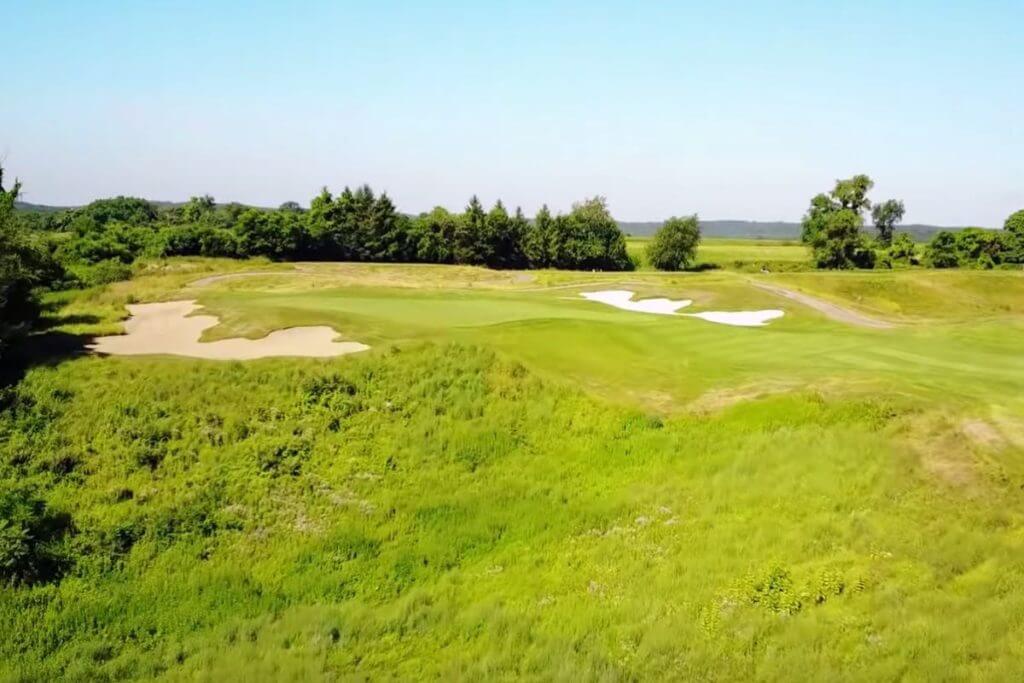
For anyone asking why Ballyowen, (a) it’s public and often ranked among the Top-5 public courses in New Jersey and (b) it’s a Golficity favorite.
Ballyowen has four separate Men’s Tees: Black (7,094 total yards), Gold (6,508 total yards), Blue (6,066 total yards) and White (5,531 total yards). For the first “experiment”, we’ll look at the second hole, which has yardages of 342, 312, 282 and 271, respectively. It’s worth noting that this hole is also the 11th hardest hole, which, in my opinion, makes it a very fair hole to use to illustrate my point.
Using the the USGA/The R&A’s own-admitted 216 yards distance (the 2019 men’s overall combined driving distance average), the hole plays as follows from the Gold tees.

Arguably, this isn’t the appropriate tee for a golfer who can only smack it 216 yards off the tee, but I think moving our “control” golfer forward would only be kicking the USGA and The R&A while they’re down… So let’s move on.
Playing the same hole using a 20% reduced flight ball (a number that’s often been floated around by its supporters) from two tees forward (White), leaves you here:

For anyone who’s having a hard time comparing to two, allow me to summarize: the reduced flight ball obviously goes less distance (216 vs. 173 yards), but, more troubling, is that it also leaves you ~20 yards further away from the hole with a significantly more demanding, forced carry shot into the green (presuming the goal here is to still get GIRs to help you score low).
Further compounding the problem is that the current ball, despite playing from the further tees, leaves you with a 136 yard shot. For most of us this a solid struck 8 or 9 iron, which is probably what you should have in your hands for an approach shot on a decent length Par-4. In contrast, the forward tees shot leaves you 156 yards out, but because of the reduced-flight ball, you need to play the shot as if it’s 190 yards. Not sure about you, but that’s a well struck 5 iron for me. And that’s not a fun green to be sniping at from almost 200 yards away.
View this post on Instagram
This point equally stands on the Par-3, sixth hole—your classic island green virtually surrounded by water. From the Gold tees the hole is 174 yards, while from the Whites its 122 yards. While from the further, Gold tees I’m hitting a stock 6 iron (which presents a certain challenge that rewards well struck shots on a Par-3), I need to play the closer, White tees as they are 120% longer and use a 8 iron to cover the playing-as distance of 146 yards. For what it’s worth, anyone who’s interested in playing from the Gold tees with a distance-reduced ball, you’re now playing that same hole as if it’s 210 yards. For me, that’s stretching out a 4 iron and, on a windy day (which there are plenty of at Ballyowen), that’s hoping I could stick a solid 5 Wood on the green to set up par. Fun, maybe? But certainly not when you’re not trying to score.
Further expanding on that last point, it’s worth pointing out that Shot Scope, who’s recorded and analyzed more than 22 million shots, has analyzed its wealth of data and found that golfers with handicaps of 8 and higher are hitting greens in regulation less than 30% of the time. Mind you, while it’s highly unlike that your local golf course won’t be getting physically longer,which is the USGA and The R&A’s “biggest concern”, a reduced flight golf ball will essentially turn a modest 6,500 yard track (the Gold tees at Ballyowen) to play like a 7,800 yard course (almost 700 yards longer than Ballyowen’s tipped out).
You see, the USGA and The R&A’s is asserting that distance is the most detrimental to golf because it’s created an environment where golf courses are entering an arms race to see who can have the largest total yardage. The obvious consequences here are that (a) there is a finite amount of land and resources and (b) more land requires more resources which requires more money.
While this is certainly bad for the environment (and your wallet), the USGA and The R&A make it seem like a new golf course is being built every day with the sole development goal being to host a PGA Tour event and, as a result, Bambi is being shoved onto the highway into oncoming traffic and that courses must be at least 8,000 yards with enough water features to drain Niagara Falls and enough bunkers to empty the Sahara.
Additionally, the USGA and The R&A’s position has, in effect, diminished all of the technological and fitness advancements that have been made possible in the past 10 years. I mean, launch monitors went from some outrageously expensive piece of equipment that needed to be rolled out onto the range (which I could only imagine how inaccurate it was) during the 1990s, to something the size of a carry-on, albeit still very expensive, that can tell you every ounce of data you need to help maximize your potential with the help of a coach. Combine this with the growth of custom club fitting through places like Club Champion and advancements in fitness with the help of TPI, it’s only right that people who actually invest time, money and energy into their game be rewarded. As Phil Mickelson pointed out, “I also don’t feel that you should punish the athletes for getting better…Now you are talking about trying to roll it back because [DeChambeau] made himself a better athlete? I don’t know if I agree with that…”
Phil also stated that because he’s not an expert on how distance impacts land-usage, but, in my opinion, if the USGA and The R&A really wants to roll out the creation of a six figure yardage golf course, then perhaps they need to look in the mirror and stop encouraging the creation of such courses, who often do so in the hopes of, one day, hosting a PGA Tour event. Instead, reward courses like Pebble Beach but then understand that a handful of premium, executive courses, like the The Ocean Course, Pinehurst No. 2, Erin Hills and Whistling Straits, will invariably have their place too.
Options are good, and it would be nice to see guys on the Tour who have completely different styles of play, such as Koepka and Kevin Kisner, battling it out. Distance will always be a weapon, but proper course design that forces a risk/reward calculation presents something unique that will, in all likelihood, draw more golfers in.
Embed from Getty Images
Indeed, from all the golfers (who, in my humble opinion, should be the #1 focus of the ruling bodies) I’ve spoken with, a quality, fun and even challenging design—NOT length—primarily dictates (perhaps only second to cost) whether someone is going to tee it up. That’s why some of the top public (i.e., accessible) golf courses in the world, such as St. Andrews (Old Course) (6,721 yards), Pebble Beach (6,828 yards), and Pacific Dunes (6,633 yards) and Bandon Trails (Bandon Dunes) (6,759 yards), aren’t longer than 7,000 yards, despite several being built within the past 20 years and having ample land (and funds) to do so. So to the USGA and The R&A’s #1 concern, I say, “don’t worry,” because what golfer enjoys paying over $100 just to play the 7,500 yard course where
Like I stated earlier, I thought we were all on the same page with trying to grow the game? But if we’re expected to fall in line and listen to USGA, The R&A and the talking heads, it’s hard not to raise the alarms due to the entirely realistic and foreseeable problem that would be caused by a reduced-flight ball: retaining golf’s current enthusiasts.
I mean, reducing distance isn’t going to make golf more affordable and appealing to the average joe who actually pays out of his own pocket to pay. Instead, it’s more likely that reduced flight balls—the landmark change being proposed to help “golf best thrive”—will only result in longer rounds (because there’s about a 3% chance you’ll move forward from the tees you’re accustomed to playing) and, for the less patient, drive people to quit out of sheer frustration, anger and defeat.


Ocean City Golf Trip Guide: Great Courses, Affordable Golf & A Beach Town Vibe

LIV Golf Could Be Facing its Final Chapter

Foresight GC2 Review: A Surprisingly Affordable Launch Monitor From Foresight

FIRST LOOK: Rapsodo MLM2XPRO Adds Putting, Faster Performance & More

FIRST LOOK: Titleist’s 2027 Pro V1 and Pro V1x Are Officially Showing Up on Tour
FIRST LOOK: Rapsodo MLM2XPRO Adds Putting, Faster Performance & More
Foresight GC2 Review: A Surprisingly Affordable Launch Monitor From Foresight
FIRST LOOK: Titleist’s 2027 Pro V1 and Pro V1x Are Officially Showing Up on Tour
LIV Golf Could Be Facing its Final Chapter
Ocean City Golf Trip Guide: Great Courses, Affordable Golf & A Beach Town Vibe

We Played This Old Golf Course Where Thomas Edison Was A Member

Are You MEASURING Your Golf Swing Correctly? (This Can Help)
Zach Johnson Explains Why He Didn’t Pick Bryson DeChambeau for the Ryder Cup

Justin Thomas FIRES Coach before Ryder Cup…Who’s Next?