
Training & Fitness
4 Golf Exercises to Overcome Common Swing Faults

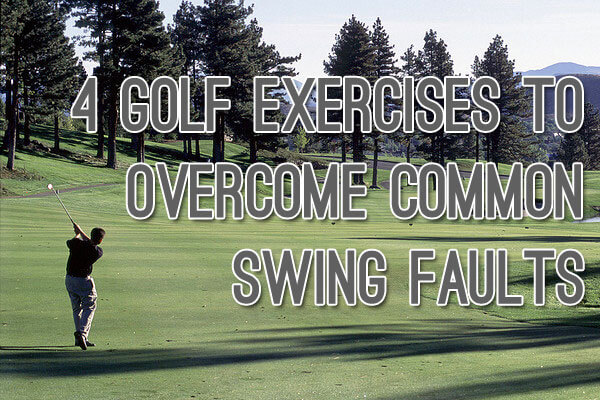
There are many ways to swing a golf club. Maybe you have a nice, smooth technique like Rory McIlroy. Or maybe you have a more unconventional approach like Jim Furyk. With either swing, you can hit winners as long as you maintain your posture throughout your entire swing.
Loss of Posture and Over the Top are two predominate swing faults that can cause problems out on the course. Both center around the inability to maintain posture throughout your swing. Often times, your swing really isn’t the problem though. It’s your body that’s actually limiting you. So let’s take a look at a few reasons this might be happening to you.
Inability to Disassociate Your Upper and Lower Body. Golfers need to be able to rotate their torsos (upper body) while keeping their hips (lower body) relatively still. Being able to do this properly will allow you to get full rotation in your backswing and enables you to generate massive power through your hips as you swing through and hit the ball.
Shoulder/Latissimus Dorsi (Lats) Flexibility. Here’s a quick test to check your lat flexibility. Stand with your back to a wall. Make sure that your head, back and glutes are all touching the wall and remain touching through the entire exercise. Put your arms out in front of you so they are parallel to the ground with palms facing each other. Keeping your elbow straight, reach your right arm back and try to touch the wall. Bring it back to neutral and repeat with your left arm. Can you touch the wall? If the answer is no, you are one of many who has tight lats. Working to increase your shoulder and lat flexibility will allow you to rotate more freely in your swing. This will help keep your torso down and prevent you from losing posture.
Thoracic Mobility. This is one of the first areas of the back that becomes “stiff” or loses range of motion. The thoracic spine begins around the base of your neck and continues down past your rib cage. When any part of the spine loses mobility, other parts begin taking more of the load. Most commonly it will surface as neck or low back pain. Doing exercises to maintain proper thoracic mobility will help fend off nagging injuries and allow for a full range of motion swing.
Lower Body Instability. It’s important that you are able to stay grounded with energy through your feet and have the ability to properly distribute and shift your weight during your swing. Working on your lower body proprioception and balance will help give you a stable base and allow for more power generation from the hips and legs.
Next, let’s take a look at 4 golf exercises that you can do to help overcome these common swing faults and body limitations.
- Torso Rotation. Start in your address position and then cross your arms over your chest. Keeping your lower body still, rotate your upper body from right to left with a slow, smooth motion. Once you have mastered this, try it while balancing on a single leg. Make sure to maintain good form by keeping your lower body still and letting all of the movement come from your torso and upper body. Rotate to each side for 10-15 repetitions.
- Seated Twist. Start by sitting on a bench or chair. Place a small ball or round foam roller between your knees and hold it tight in order to stabilize your lower body and prevent it from moving. Now sit up tall and place your hands behind your head in the surrender position. Begin to twist from right left making sure that you maintain your posture (no leaning forward) and that your legs are not moving. Rotate to each side for 10-15 repetitions.
- Open Books. Start by lying on your left side, legs stacked on top of each other and bent at 90 degrees. Arms are stretched straight out with palms together. Keeping your right arm straight, rotate it over your body like it’s a page turning in a book. It’s important to only reach as far as your body allows. Your legs should not move or come off the ground. Repeat for 10-15 repetitions and then turn over to your right side and repeat with your left arm.
- Reverse Wood Chop. Place a cable or band in a low position. Stand with your right side facing the cable and take the handle in both hands. Now squat down and as you come up, simultaneously pull the cable in a diagonal direction from low to high. You should end standing with arms outstretched past your left shoulder. Now lower yourself back into your squat as you lower the cable down and repeat. Try to do the exercise with a fluid motion. Repeat for 10-15 repetitions and switch to the left side.
You don’t need to have the “perfect” golf swing. Learning the capabilities of your body is key. Start with these exercises to help create flexibility, range of motion and stability in your swing and avoid the common swing faults that are hurting your game.


LIV Golf Could Be Facing its Final Chapter

Foresight GC2 Review: A Surprisingly Affordable Launch Monitor From Foresight

FIRST LOOK: Rapsodo MLM2XPRO Adds Putting, Faster Performance & More

FIRST LOOK: Titleist’s 2027 Pro V1 and Pro V1x Are Officially Showing Up on Tour

2026 Presidents Cup Preview: Did Team USA Get It Right?
2026 Presidents Cup Preview: Did Team USA Get It Right?
FIRST LOOK: Rapsodo MLM2XPRO Adds Putting, Faster Performance & More
Foresight GC2 Review: A Surprisingly Affordable Launch Monitor From Foresight
FIRST LOOK: Titleist’s 2027 Pro V1 and Pro V1x Are Officially Showing Up on Tour
LIV Golf Could Be Facing its Final Chapter

We Played This Old Golf Course Where Thomas Edison Was A Member

Are You MEASURING Your Golf Swing Correctly? (This Can Help)
Zach Johnson Explains Why He Didn’t Pick Bryson DeChambeau for the Ryder Cup

Justin Thomas FIRES Coach before Ryder Cup…Who’s Next?

Thank you so much for this article. as a new golfer I have found that limitations in mobility and flexibility are issues I have to address immediately before I can progress in my golf game. How can I work on improving my golf swing, if my body can’t do the proper motions? I can’t! So I have started a regiment that includes Kettle-bells exercises, and regular yoga practice. My targets are increased flexibility, balance, and core strength.