
Golf Courses
Baltusrol Golf Club: Returning to the Golden Age with Gil Hanse

C.B. MacDonald, Donald Ross, Alister MacKenzie, Seth Raynor. These names may sound familiar, and they should—they are a members of the Golden Age of Architecture, and are responsible for some of the most drool worthy courses on earth: Shinnecock Hills, Cypress Point Club, National Golf Links of America, Fishers Island Club, and several others.
What made the works performed by these men miracles is that they created golf courses at a time when you truly had to work with the land. There were no, multi-ton excavators and dump trucks to complete rework the land; you had to more or less take what you had and, with the help of shovels and horse plows, make something special.
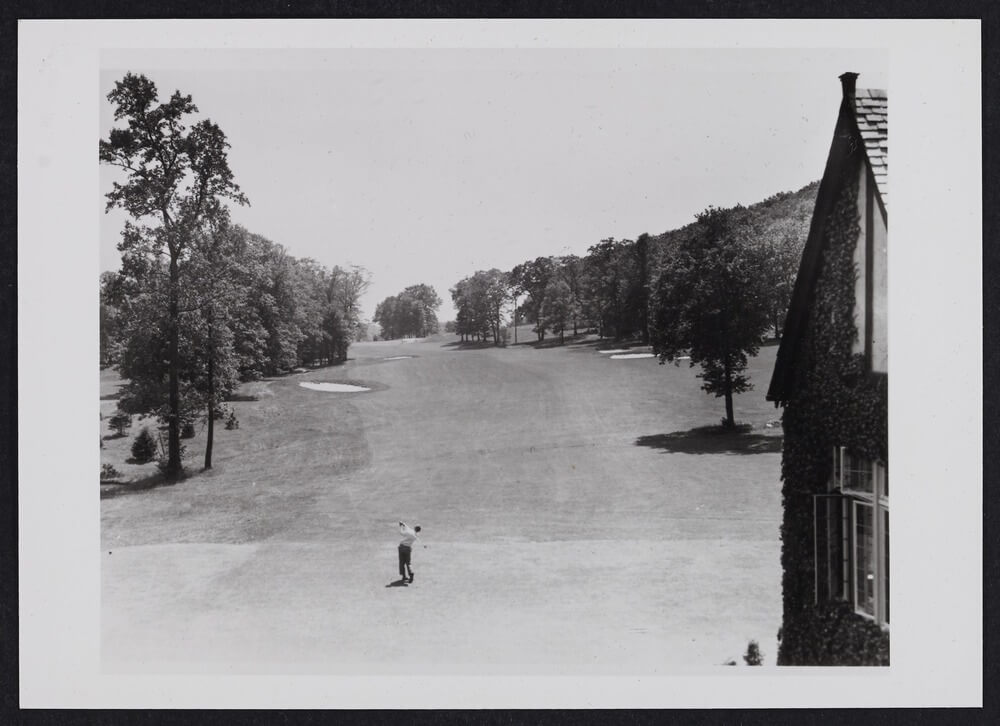
The 1st on the Upper Course
And that’s exactly what A.W. Tillinghast did with the beautiful piece of land in North New Jersey. Going back to the 1920s, Baltusrol Golf Club commissioned Tillinghast to add a second course to the property, but, after some negotiations, Tillinghast convinced the club to build two, all-new 18-hole courses. During June 1922, Tillinghast unveiled the fruits of his work: the Lower and Upper Courses.
The courses were met with praise and hosted champions, starting with the Lower hosting the U.S. Amateur 1926, and the Upper hosting the U.S. Open in 1936.
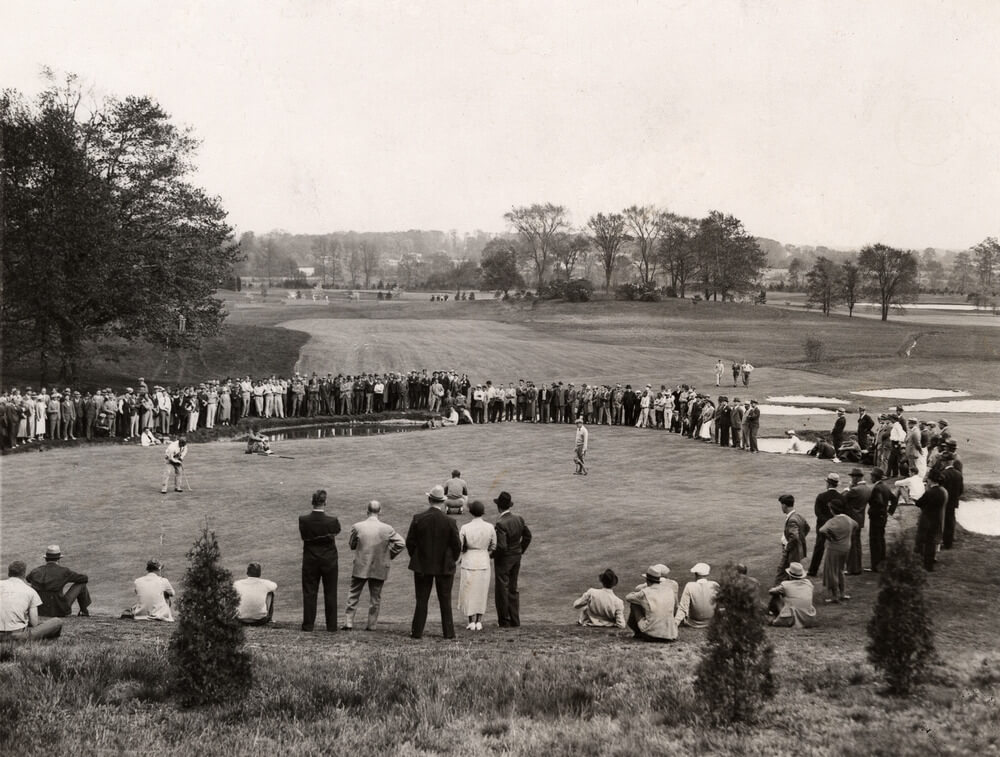
More than 100 years have passed since the first rounds were played on courses, but those years are filled with history—including Baltusrol becoming the first course to host both the U.S. Open and Women’s U.S. Open on two different courses—and some changes.
As to changes, they can be good and bad. And the problem with inevitable passage of time is that the original designer is no longer available to ask how he’d update or modify the course to keep it current with, among other things, equipment, environmental and agronomy changes or member playing preferences. In sum, Baltusrol deviated from Tillinghast’s original vision for the courses over the decades that followed.
Fortunately, the Baltusrol membership decided that it was time to bring their two courses into the future by turning to the past. To explain, the membership decided that, with the help of historical photographs, aerial maps and plans, it was time to restore the courses to what Tillinghast had envisioned. And to accomplish this feat, the membership selected Gil Hanse.
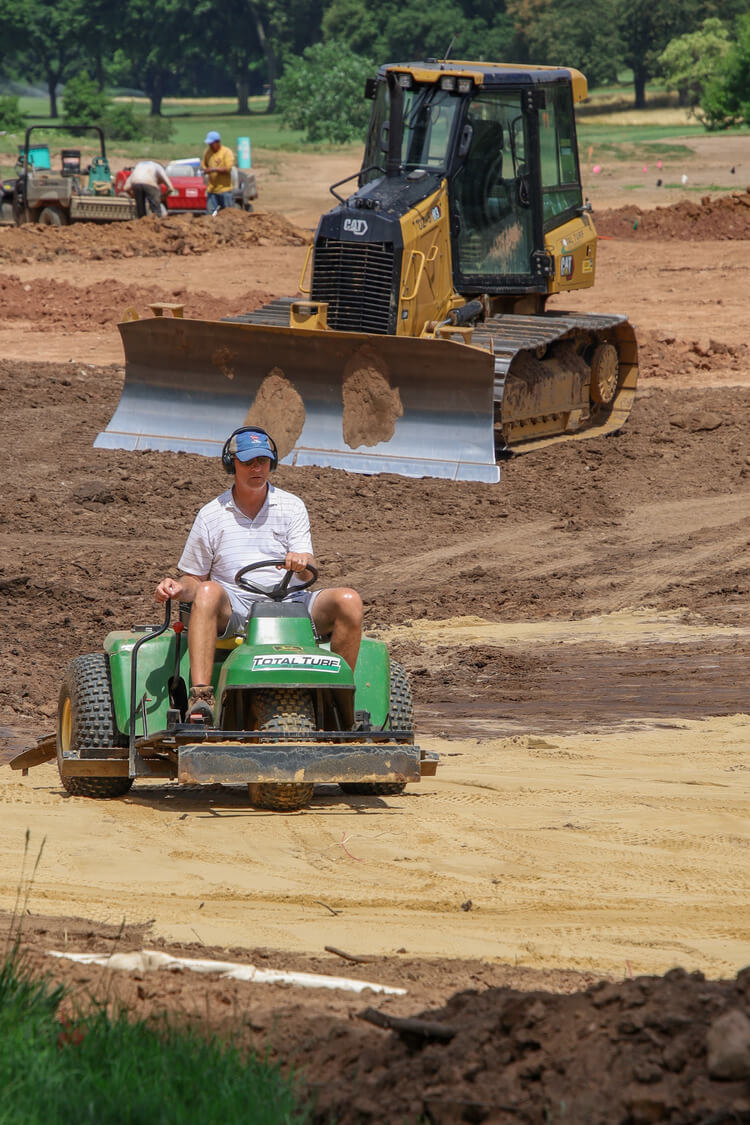
Gil Hanse: the Man Behind Baltusrol’s Restoration
For those familiar with the name, Hanse’s original works include the Olympic Golf Course in Rio, the Cradle at Pinehurst and Streamsong’s Black Course. But equally noteworthy are his restoration projects, which have garnered overwhelming praise from golfers who’ve been able to see and experience the before and after. Sleepy Hollow and Winged Food, for example, have been blessed by Hanse’s commitment to restore the course to a form that would make the designer proud.
View this post on Instagram
Baltusrol’s restoration started in 2018 with its Lower Course (pictured above), and concluded just this spring with the Upper. Work that isn’t visible to the eye includes all new drainage and irrigation systems and Precision Aire technology beneath all of the greens. The visible changes, however, feel even more impactful.
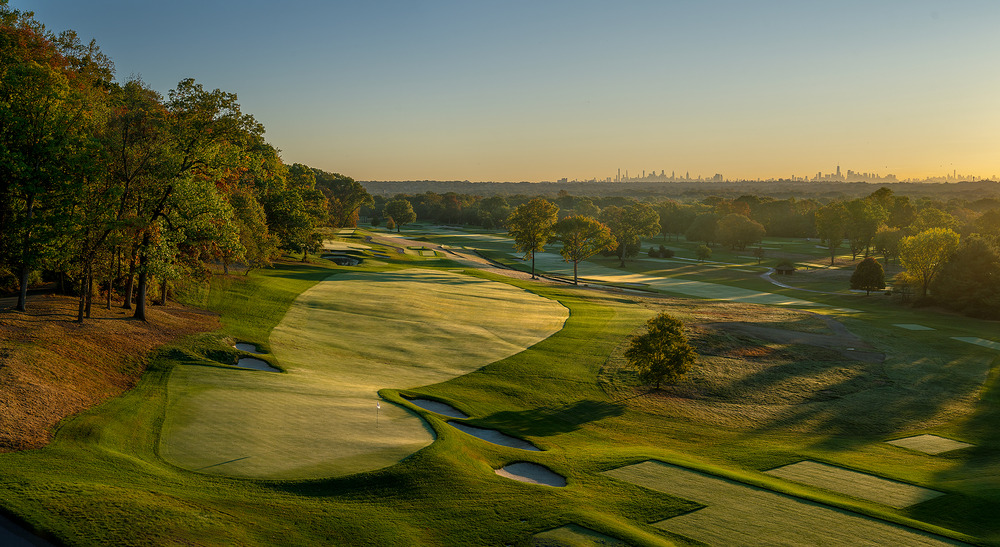
4th Hole on the Upper Course,
with the Manhattan Skyline in the Background
Green surfaces were expanded, bunkers were rebuilt and, perhaps most significant, trees were removed and replaced with native fescue, resulting in beautiful views across the entire property.
While the views of the New York City skyline are drastically different from what Tillinghast may have looked at, the changes bring the beauty back to this course nestled less than 30 miles from Manhattan. While the prior iteration of the courses featured more dense vegetation that fostered an isolated experience on each hole, the Hanse restoration brings a deep breath of fresh air into the property. As a result, you not only can truly grasp the range of elevation and undulation in the terrain, both on the hole you’re playing as well as those that are neighboring, but there’s now a sense of community, as you can see other golfers working their way from tee boxes to fairways and greens under the guidance and assistance of Baltusrol’s invaluable caddies.
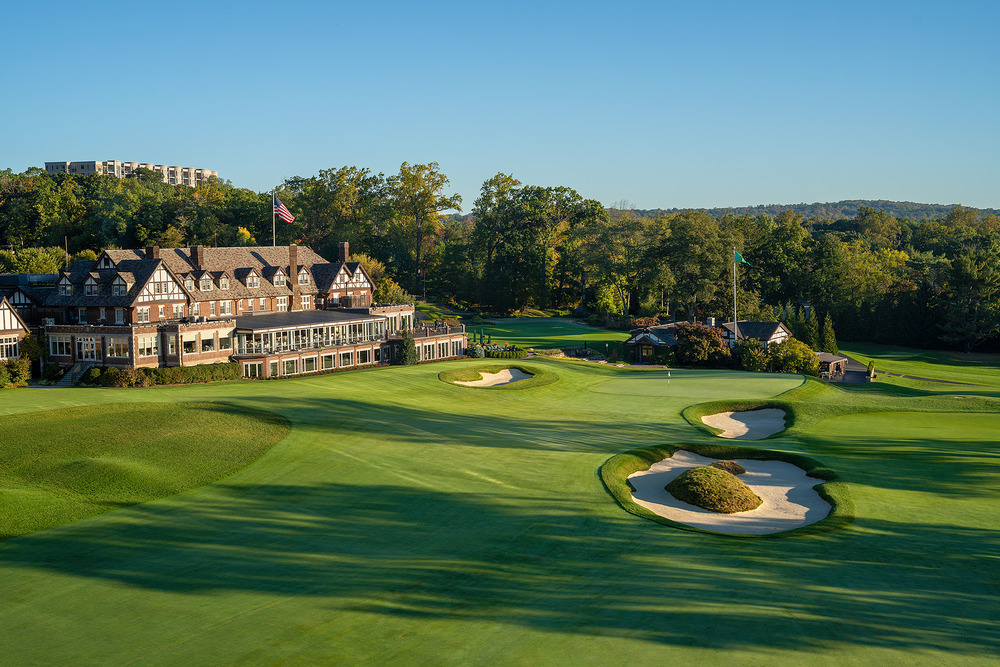
Baltusrol’s Clubhouse Looks Out the Upper’s 18th Hole,
Which Features a Seamless Transition to
a Practice Green and 1st Tee (located on the left, but not pictured)
I must admit that while I had the opportunity to play both the Upper and Lower a few weeks ago, these are not my photos; Mother Nature decided grey, overcast weather is all I would be provided while walking the 36 holes. But I can assure you that both courses were incredibly fun. It’s clear why the Upper is the tournament venue; bunkers happen to magically appear whenever you tee and approach shots stray from your intended target. And then the fun really begins once you arrive at the greens. But that doesn’t mean the Lower should be overlooked. Indeed, it’s the preferred course about the membership, and it’s easy to see why. With several holes being worked into the hills, there are countless beautiful views of the property. Indeed, while working your way through the first few holes, you can preview many of the holes on the back nine.
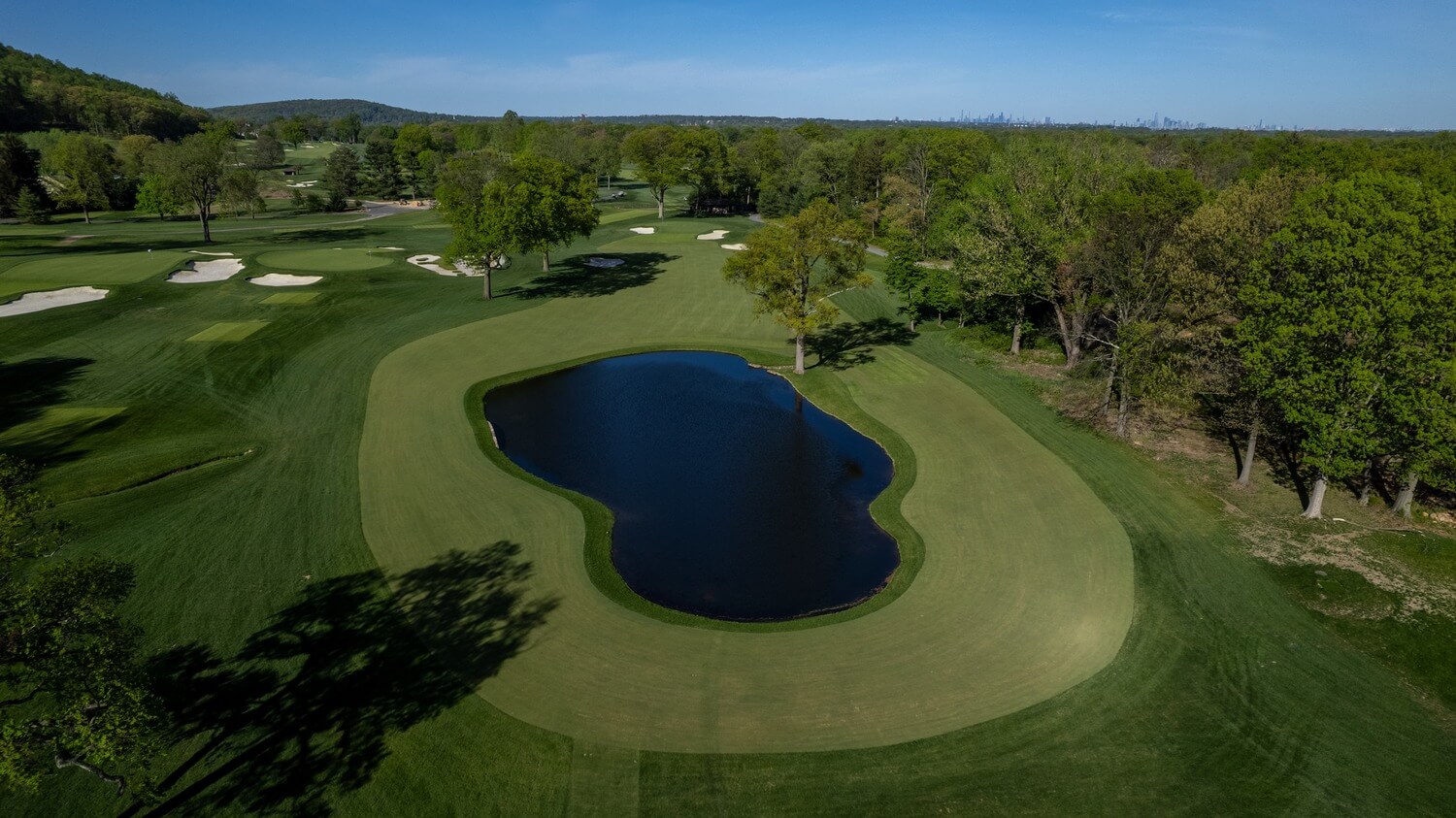
The Par-4, 8th Hole on the Upper Course features
a water hazard off the tee that can be carried by most golfers
Consistent with the membership, I found the Upper a little more relaxed and fun (whereas the Lower felt like serious, “execute shots or get punished” golf). And thinking back on my round, the two holes that stand out are Nos. 8 (pictured above) and 14 (pictured below).
On the Par-4, Eighth, you tee off a small lake situated in the middle of the fairway. For most hitters, it’s not in play, but for the longer golfer there’s some strategy in not only navigating the water hazard but also threading your way through the trees. Two good shots leave you with a good chance at birdie, which can be immediately celebrated at the halfway house that’s merely steps away.
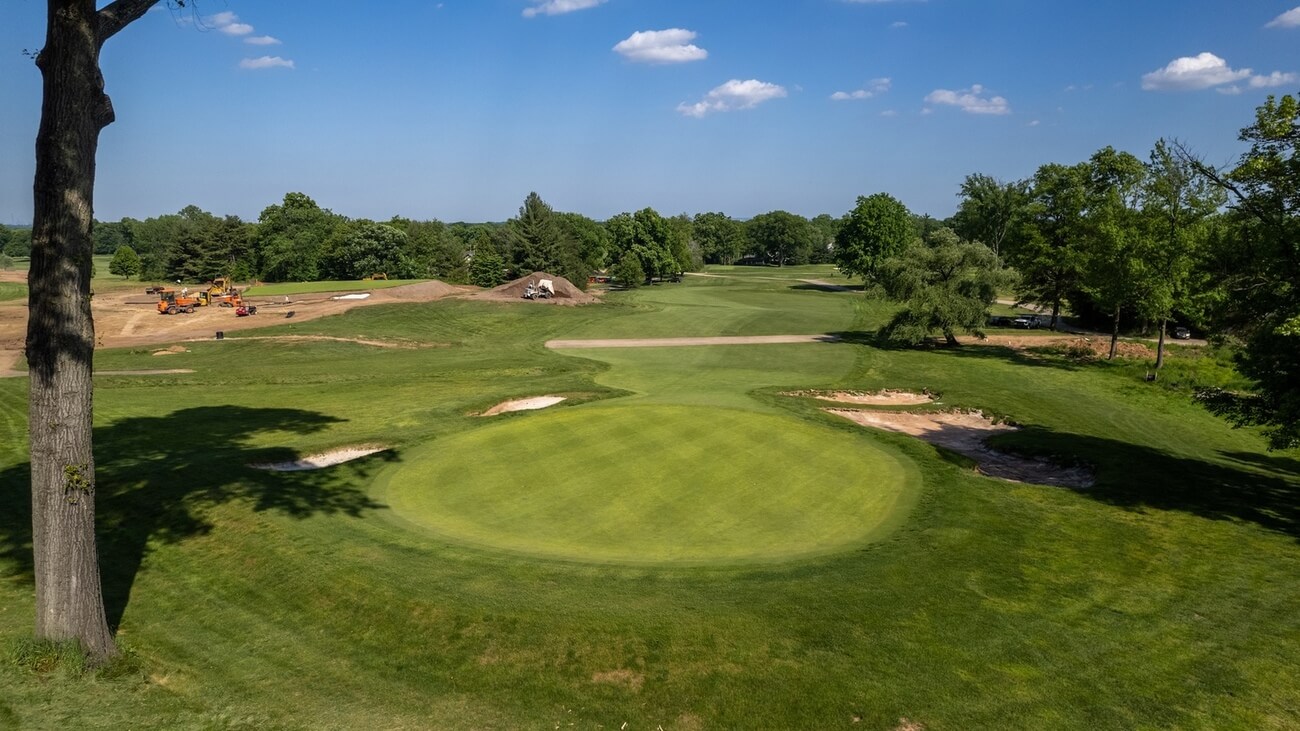
The Par-4, 14th Before Hanse’s Renovation;
Notably Missing is the Lower Green
The Par-4, Fourteenth starts with a partially blind tee shot as you work your way up the hill to a double-green. You didn’t misread that; Tillinghast designed the Fourteenth hole with two greens—the upper available for when the lower, adjacent to a river, was flooded—separated by some strategic bunkering. Hanse, after much deliberation, went through the effort of restoring both greens, providing some additional variability to the hole.
Depending on which green is in play and your approach shot, you could be hitting blindly into the lower green, in which case, you better know your target line and distance to ensure you don’t find yourself in the river or greenside bunker.
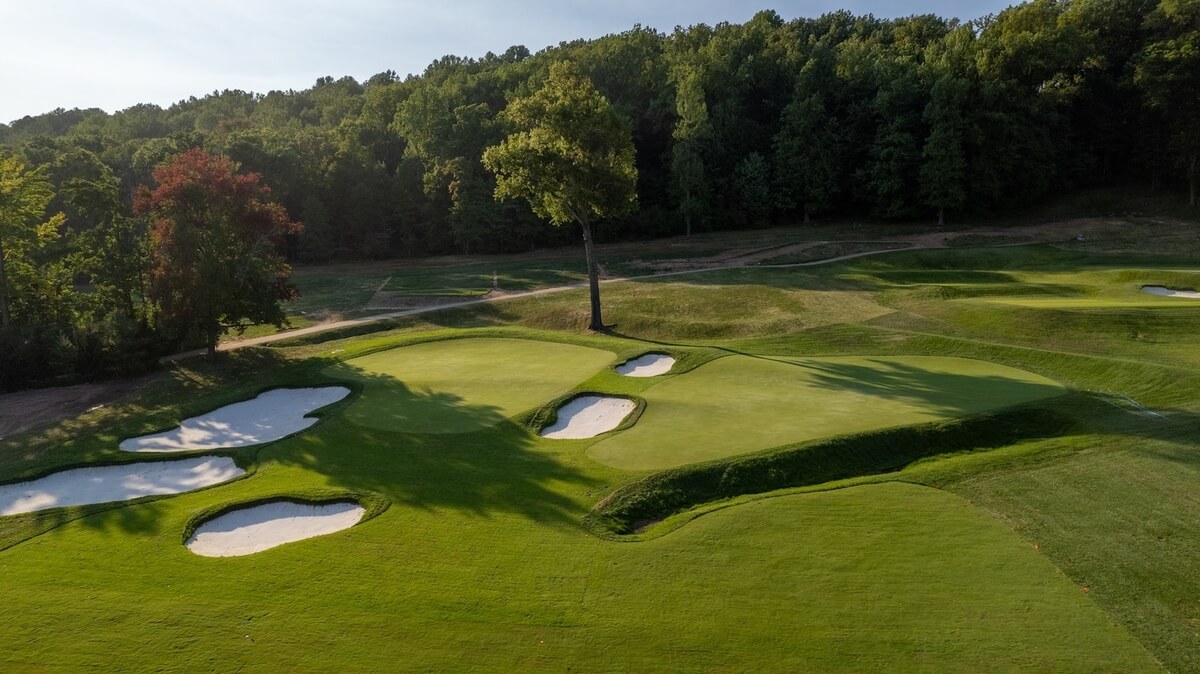
The Hanse-Restored Par-4, 14th
Featuring Tillinghast’s Double Green
Baltusrol is a private club, so it’s unfortunate that not ever golfer will have the opportunity to play and enjoy one of Tillinghast’s greatest works (fortunately, the Bethpage Courses are just a car ride away). But if you ever get the chance to play the Upper or Lower, take it. You’ll be blessed with the opportunity to walk into a time capsule and experience what golf was like the designers truly had to “work with the land” and use their genius to turn tin into gold.
And if you get a chance to enjoy both, well, do whatever you have to clear your schedule to enjoy these neighboring masterpieces.


LIV Golf Could Be Facing its Final Chapter

Foresight GC2 Review: A Surprisingly Affordable Launch Monitor From Foresight

FIRST LOOK: Rapsodo MLM2XPRO Adds Putting, Faster Performance & More

FIRST LOOK: Titleist’s 2027 Pro V1 and Pro V1x Are Officially Showing Up on Tour

2026 Presidents Cup Preview: Did Team USA Get It Right?
2026 Presidents Cup Preview: Did Team USA Get It Right?
FIRST LOOK: Rapsodo MLM2XPRO Adds Putting, Faster Performance & More
Foresight GC2 Review: A Surprisingly Affordable Launch Monitor From Foresight

Turning Stone: The Northeast’s Most Underrated Golf Destination
FIRST LOOK: Titleist’s 2027 Pro V1 and Pro V1x Are Officially Showing Up on Tour

We Played This Old Golf Course Where Thomas Edison Was A Member

Are You MEASURING Your Golf Swing Correctly? (This Can Help)

Zach Johnson Explains Why He Didn’t Pick Bryson DeChambeau for the Ryder Cup

Justin Thomas FIRES Coach before Ryder Cup…Who’s Next?

What Nobody Tells You About Great Ball Striking
-
 Equipment1 week ago
FIRST LOOK: Rapsodo MLM2XPRO Adds Putting, Faster Performance & More
-
 Equipment1 week ago
Foresight GC2 Review: A Surprisingly Affordable Launch Monitor From Foresight
-
 Equipment1 week ago
FIRST LOOK: Titleist’s 2027 Pro V1 and Pro V1x Are Officially Showing Up on Tour
-
Podcasts2 days ago
LIV Golf Could Be Facing its Final Chapter