
Golf Instruction
“Keep Your Head Down” Is NOT Bad Golf Advice

If you enjoy staying up to date on today’s instruction-related content, there’s a good chance you’ve come across Golf Digest’s-&-Golf.com’s latest-pieces that tell us “NOT to keep our head down.”
Basically, modern-day instructors like Sean Foley, Chris Como, and others have made a living searching for ways to debunk traditional theories/beliefs about the golf swing.
While much of what they say has some level of sophistication and accuracy to it, it’s also important to understand their vantage-points before making any conclusions of your own. For the most part, Sean Foley became the well-known instructor that he is today during his years coaching Tiger Woods; from roughly 2011 to 2015.
At that time, Tiger was coming off of a slew of major knee-injuries and was looking to change his swing in a way that placed less stress on his knees/lower-body. Essentially, Tiger was looking for a golf-instructor who knew a great deal about the body’s movements (/biomechanics) and how the body is “supposed” to move/function properly during the golf swing; or in a way that holds up over time. Enter Sean Foley.
While Foley gave Tiger the keys to a new golf swing that helped him win nine-times from the end of 2011 thru 2013, the duo’s demise arrived in the aftermath of Tiger’s back/neck failing to cooperate (with him) throughout the majority of 2014 and ‘15.
From what I’ve been told, Foley was never able to win Tiger over on one-idea: head movement.
If you watch the swings of Henrik Stenson, David Duval, Annika Sorenstam, and even Rory McIlory; you’ll notice their heads rotating-&-moving laterally towards the target on-the-downswing. Unlike many Sean Foley pupils including Justin Rose, Hunter Mahan, and others; Tiger wasn’t going to increase his head’s movement during his swing.
Mainly, Foley believes that adding some head rotation and lateral-movement during the downswing is key for reducing stress on your back/neck muscles over time. With more head-movement, Foley argues, there’s going to be less vertical-movement/force/stress that’s applied.
Essentially, Foley’s teaching philosophy emphasizes the kind of body-movements that are designed to be more sustainable. According to Foley, allowing your head to move backward away from the target and forward during the swing is an achievable-skill that’s been discouraged by traditional methods/instructors for as long as golf’s been around.
Now, who am I to argue with Sean Foley?
He’s probably forgotten more about the golf swing than I will ever learn. With that being said, the relationship between your hands and line-of-sight; or your hand-eye coordination, is the hallmark of playing good-golf. Every great golfer has exceptional hand-eye coordination.
If anyone tells Tiger Woods or any golfer who’s been playing the game (thru maintaining limited head-movement) for several years to start moving their head around during the golf swing, it’s hard. Very hard. Personally, I’ve never undergone a change of which was that awkward-&-difficult in my entire golfing life. After emphasizing head-movement for a few weeks with nothing but extremely inconsistent/poor results, I had to ditch it.
Making swing-changes requires patience and having an open-mind. I tried to stay patient with my head’s movement, and I got to the point where 2 out-of every 3 strikes were incredibly pure. However, the third one? Dreadful, and it was the kind of dreadful that ends rounds via double/triple/quadruple bogeys.
In a game that emphasizes the importance of managing your misses, my misses with my new, head-moving golf-swing weren’t manageable. Sure, my typical 4-iron was traveling 215 with some added head-movement as opposed to 205-210; but that was two-thirds of my shots.
In my opinion, finding a balance between Foley’s method and traditional methods is best when trying to figure out what to do with your head during the golf swing.
If your head remains perfectly still during the golf swing; meaning it hasn’t moved laterally, vertically, or rotated, then you probably haven’t utilized enough of a hip/shoulder-turn or a weight-transfer during the back-&-down swing.
At the same time, the guy who keeps his head still is often the same guy who repeatedly finds the center of the club face. When your line of sight isn’t changing much from the time you address your golf ball to impact, it’s easier to make contact with the ball in the center of the club-face. Making contact with the center of club-face is HOW you play good-golf.
Not by chasing distance like Kyle Berkshire and other Tour pros who have the time/athleticism to maximize their physical skill-set in a way that gets the ball out-there (more).
If you’re wondering how much head-movement is ideal, I suggest watching Tiger’s swing from the year 2000.
If you watch the 24 year-old version of Tiger swing the club, you’ll notice how his head stays very “level” (/very little up-&-down movement) in relation to the ground and how his head moves laterally ever so slightly (a couple of inches) during his backswing.
On the downswing, his head is already in an ideal position to deliver the club-head into the slot in a consistent and repeatable fashion. In other words, his head’s movement is muted on the downswing; which allows him to consistently deliver the club-head into the back of the ball so that he pounds the center of the face.
Sure, if the younger Tiger implemented some more head-movement into his down-swing, he may have spared himself from the back/neck problems that popped up in his mid-to-late thirties. At the same time, however, Tiger could’ve ended up injuring himself just like a number of other head-moving swingers have (like David Duval).
Around the greens, I think excessive head-movement creates more problems than it solves.
Remember, inside 100-140 yards; or however far your pitching wedge goes, you really don’t need to transfer your weight during the swing. If we don’t need a weight transfer, then your head shouldn’t really move at all.
Around the greens, distance control/spin is created/controlled by the quality of the strike, and making sure that your strike is optimal can be a lot harder when your head is moving; and your line of sight is changing. Around the greens, your weight is mostly on your lead-foot, and your head is staying still/level. If you move your head excessively either up-or-down or left-or-right, you’re going to experience contact issues.
Sure, it’s easy to make solid-contact moving your head and whatever else when your lie never changes; or is nearly perfect every single time.
Indoors, you have a perfect lie on top of the same piece-of-turf every single time; or the ball is on a tee. The same applies on the driving range. Also, you can’t practice downhill/uphill/side hill lies at the driving range; and certainly not indoors. Indoors makes it easier to hit the ball solid when you’re moving your head. Unfortunately, golf isn’t played on a simulator.
Good luck exaggerating your head’s movement the next time you’re facing a(-ny uneven-) sidehill-lie in the rough, fairway, or in a bunker. Moving your head isn’t ideal for consistently “finding the bottom” of your swing; as Tiger often works on.
Like most other-teachings in this modern-era of instruction, being told “not to keep your head down” is just another way to (maybe-) add distance (at the expense of clean-contact) and (increase your body’s-) comfort. Too bad the average amateur isn’t hitting anywhere close to ten percent of the balls that the average Tour player hits per-day and over-time. In other words, the average golfer doesn’t have to go to desperate lengths protecting their bodies.
Also, they’re not playing golf courses that are 7200-7700 yards. The average golfer is playing courses in the 6000 yard range. In other words, making clean contact is far more important than focusing on gaining distance.
To make clean contact, you DO have to keep your head down (/still).
Cover Image via X


LIV Golf Could Be Facing its Final Chapter

Foresight GC2 Review: A Surprisingly Affordable Launch Monitor From Foresight

FIRST LOOK: Rapsodo MLM2XPRO Adds Putting, Faster Performance & More

FIRST LOOK: Titleist’s 2027 Pro V1 and Pro V1x Are Officially Showing Up on Tour

2026 Presidents Cup Preview: Did Team USA Get It Right?
2026 Presidents Cup Preview: Did Team USA Get It Right?
FIRST LOOK: Rapsodo MLM2XPRO Adds Putting, Faster Performance & More
Foresight GC2 Review: A Surprisingly Affordable Launch Monitor From Foresight
FIRST LOOK: Titleist’s 2027 Pro V1 and Pro V1x Are Officially Showing Up on Tour
LIV Golf Could Be Facing its Final Chapter

We Played This Old Golf Course Where Thomas Edison Was A Member

Are You MEASURING Your Golf Swing Correctly? (This Can Help)
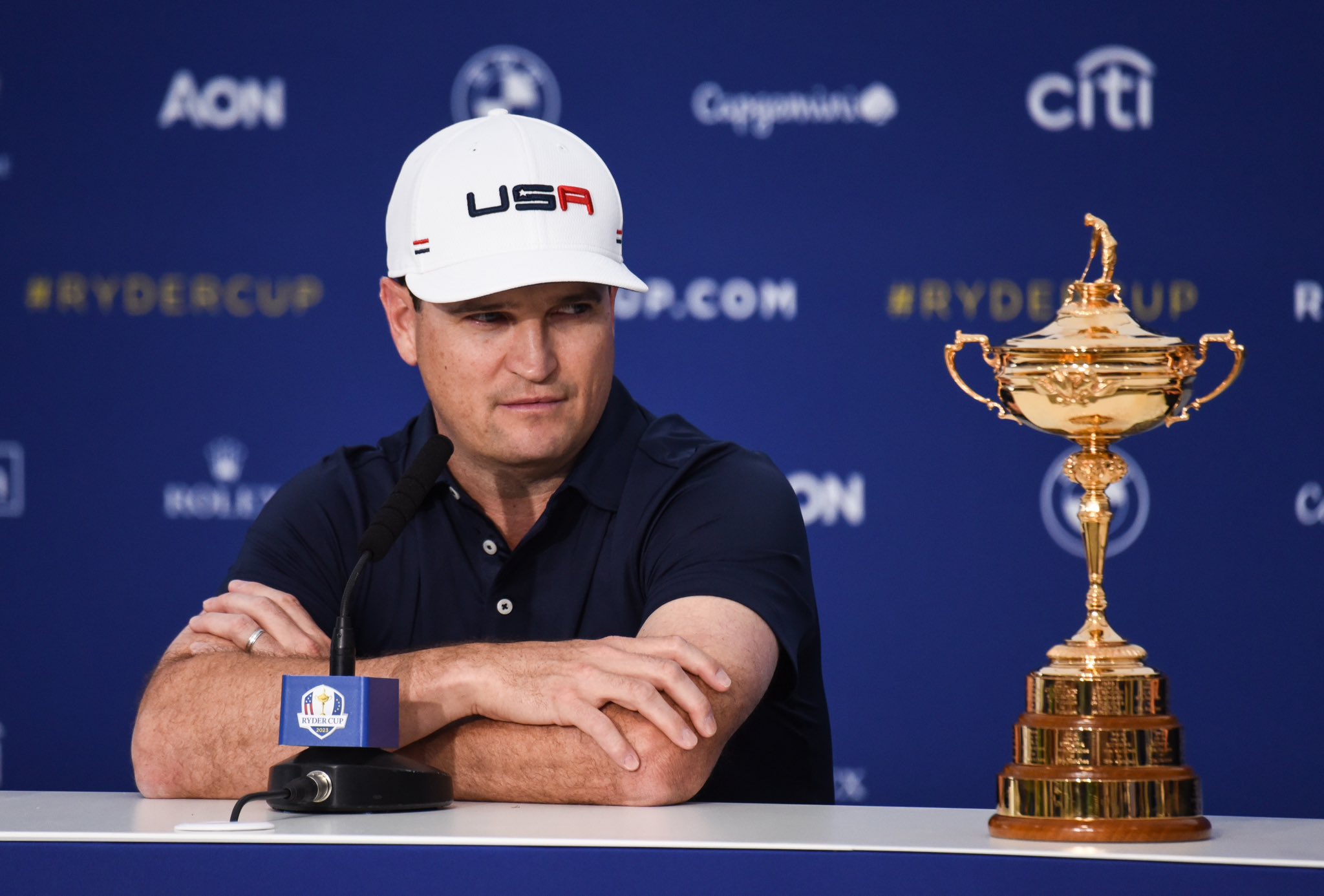
Zach Johnson Explains Why He Didn’t Pick Bryson DeChambeau for the Ryder Cup

Justin Thomas FIRES Coach before Ryder Cup…Who’s Next?
